February 26, 2026 · Gaurav Radadiya
SMS gets a 98% open rate. WhatsApp gets a 98% open rate. And restock emails, the highest-performing automated email type, get a 65% open rate (Barilliance email marketing benchmarks, 2024). So the answer seems obvious: ditch email and go with SMS or WhatsApp. Except it’s not that simple. When you compare SMS vs email vs WhatsApp for restock alerts, open rates are the least useful metric. What matters is what happens after the open, the click, the conversion, and the cost to make it happen.
This article breaks down all three restock alert channels by the numbers that matter, gives you a decision framework based on your store type, and shows you how to set up the right multi-channel restock notification strategy without overspending.
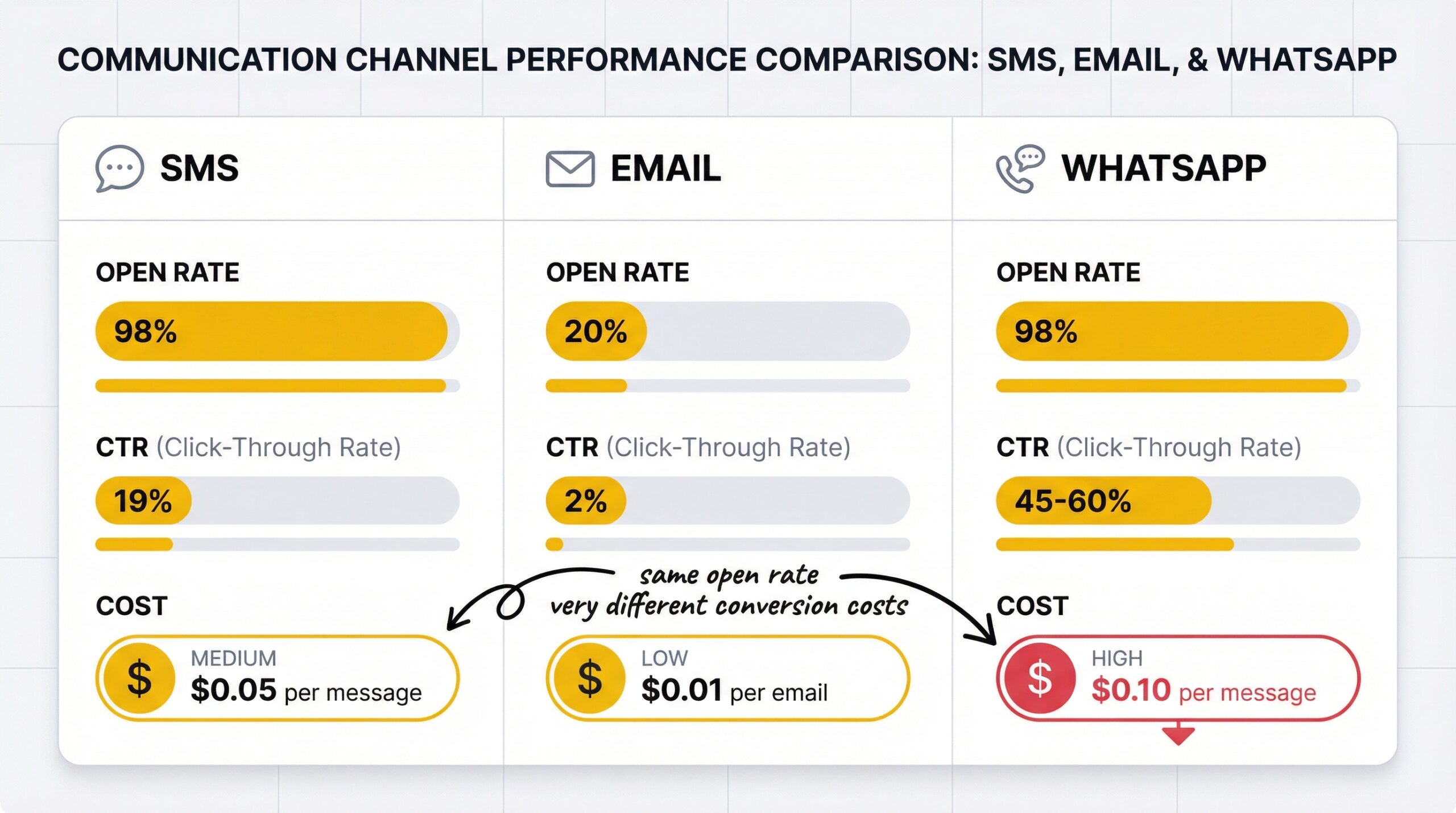
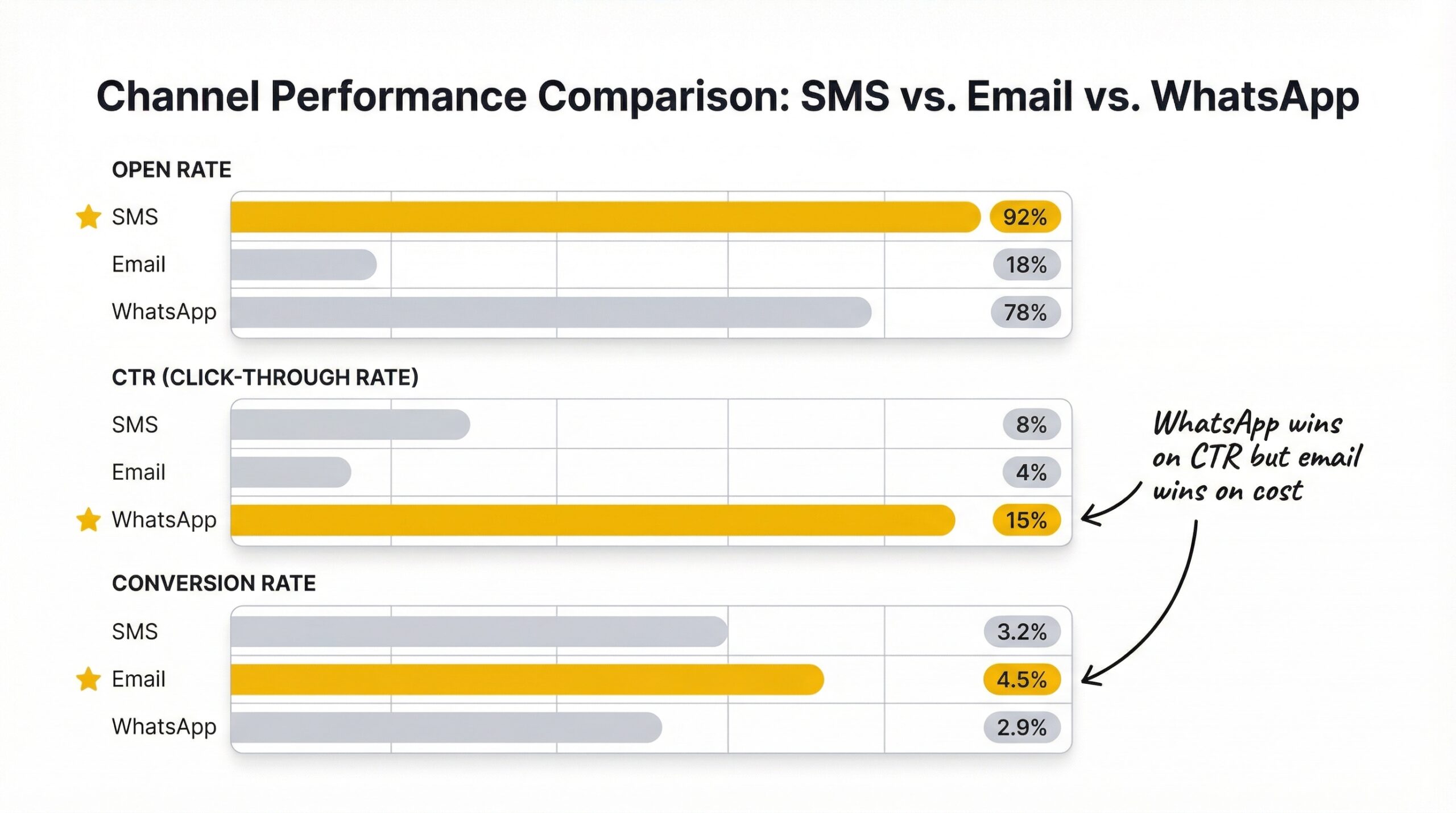
SMS, email, and WhatsApp each have distinct strengths for restock alert channel comparison. SMS and WhatsApp tie on open rates (98%), but WhatsApp delivers 45-60% CTR versus SMS at 20-35% and email at 2-5%. Email costs 10-100x less per message. The best channel for back in stock notifications depends on your audience, budget, and product type.
Here’s the full comparison:
| Metric | SMS | ||
|---|---|---|---|
| Open Rate | 20% avg (65% for restock) | 98% | 98% |
| Click-Through Rate | 2-5% | 20-35% | 45-60% |
| Conversion Rate | 5-7% | 21-40% | 18-25% |
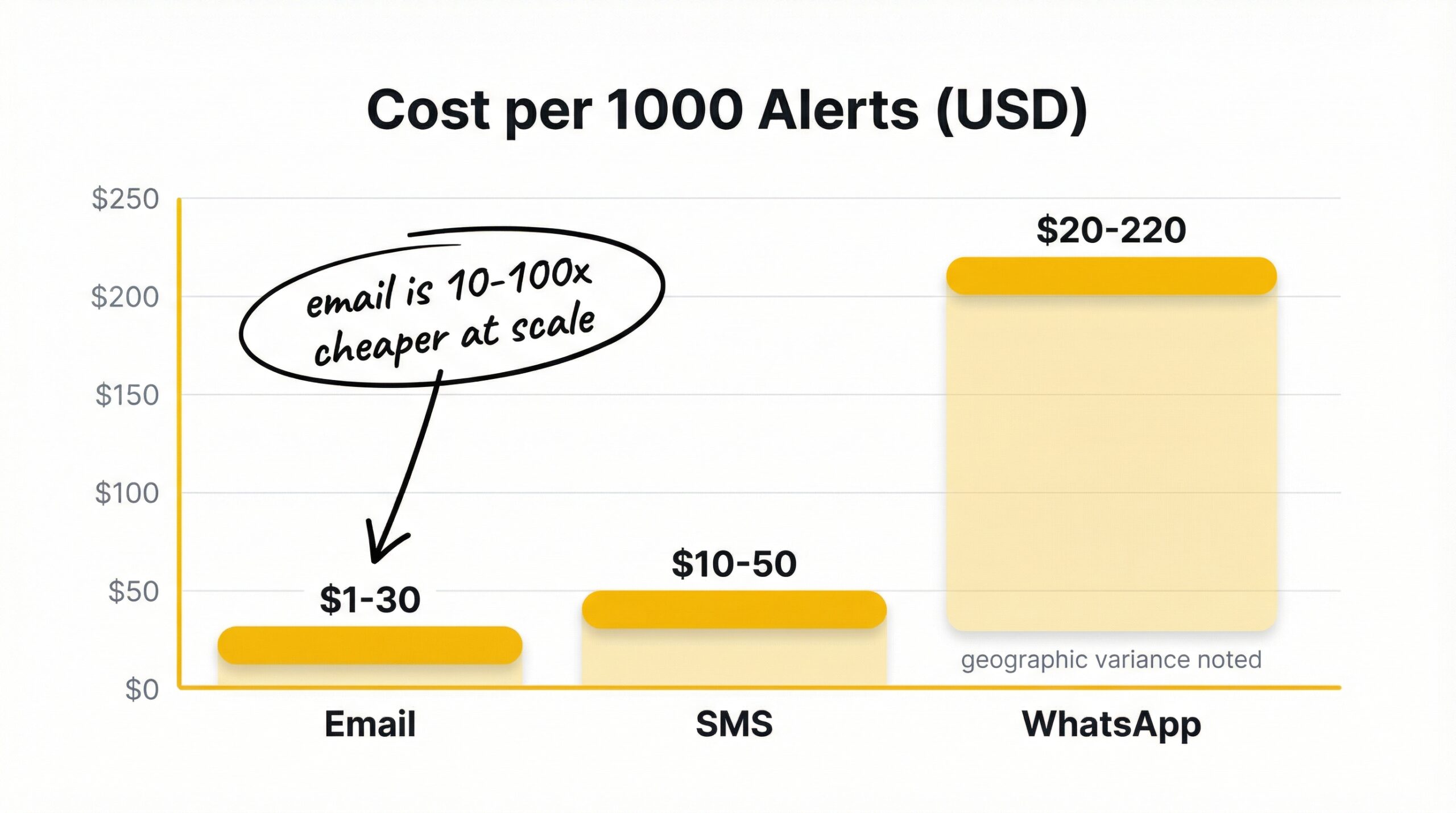
| Cost Per Message | $0.001-$0.03 | $0.01-$0.05 | $0.02-$0.22 |
| Time to Open | Hours to days | 3 minutes | 5 minutes |
| Rich Media | Full HTML, images | Text only | Images + buttons |
| Content Length | Unlimited | 160 characters | 1,024 characters |
| Deliverability | 83% inbox | 98%+ | 98%+ |
| Regulation | CAN-SPAM | TCPA (strict) | WhatsApp Policy |
| Best For | Detailed alerts | Urgent alerts | Interactive alerts |
Notice something? Email’s open rate looks weak at 20%, but for restock emails specifically, it jumps to 65%. That’s because back-in-stock alerts target customers who already raised their hand. The intent is pre-built. Understanding what stockouts actually cost your Shopify store makes the stakes clear: every channel you choose needs to recover that lost revenue, not just generate vanity metrics.
Cost per message is where the three channels diverge dramatically, and where most “SMS vs email” comparisons fall apart. The cheapest channel isn’t always the best, but overspending per alert eats into the revenue you’re trying to recover.
Email is by far the cheapest restock alert channel at $0.001-$0.03 per message. At 1,000 alerts, you’re spending $1-$30 total. Email marketing generates $36-$42 in return for every $1 spent (Omnisend marketing statistics, 2025), making it the most cost-efficient baseline.
The tradeoff: inbox placement averages 83.1% globally, meaning roughly 1 in 6 emails never reach the inbox at all (Validity benchmark report, 2025). Custom sender domains help, emails sent from your own domain get recognized by customers and trusted by mailbox providers.
SMS costs $0.01-$0.05 per message in the US. That’s 3-50x more expensive than email per send. At 1,000 alerts, you’re spending $10-$50. SMS generates $71 in ROI for every $1 spent, which is higher than email, but the higher per-message cost means you need a higher conversion rate to justify the spend.
The hidden cost: TCPA compliance. In the US, SMS marketing requires express written consent, and violations carry penalties of $500-$1,500 per unauthorized message per recipient. You also can’t send before 8 a. m. or after 9 p. m., which limits your timing flexibility for restocks that happen outside those windows.
WhatsApp marketing template costs range from $0.02 (India) to $0.22 (Germany) per message, making it anywhere from competitive with SMS to 4x more expensive, depending on your customer’s country. Since July 2025, utility templates sent within a 24-hour customer service window are free, which creates a cost advantage for stores already engaging customers on WhatsApp.
At 1,000 alerts to US customers, WhatsApp costs roughly $50-$100. For India-based customers, the same batch costs $20-$30. Geography dictates whether WhatsApp is a budget play or a premium channel.
SMS leads raw conversion rates at 21-40% across e-commerce, followed by WhatsApp at 18-25% and email at 5-7% (Sakari SMS marketing benchmarks, 2025). But raw conversion rate doesn’t tell the full story. You need to factor in cost per conversion.
Here’s the math for 1,000 restock alerts:
Email: 1,000 alerts × $0.01 avg cost = $10 total. At 5% conversion = 50 sales. Cost per conversion: $0.20.
SMS: 1,000 alerts × $0.03 avg cost = $30 total. At 25% conversion = 250 sales. Cost per conversion: $0.12.
WhatsApp: 1,000 alerts × $0.08 avg cost (US) = $80 total. At 20% conversion = 200 sales. Cost per conversion: $0.40.
SMS wins on cost per conversion in the US market. Email wins on total spend. WhatsApp wins on engagement quality (45-60% CTR means more customers actively browsing your products). The right answer depends on whether you’re optimizing for total conversions, total cost, or customer engagement depth.
Strengths: Lowest cost per message. Full HTML templates with product images, pricing, and multiple CTAs. No message timing restrictions. Universal reach, every customer has an email address. Custom sender domains build brand trust and improve deliverability.
Weaknesses: Only 83% inbox placement. Takes hours to days before customers open. Competes with dozens of other emails in crowded inboxes. Can land in promotions tabs on Gmail.
Best for: Detailed product showcases, multi-product restock digests, brand-building alerts. If you want to see what high-converting restock emails look like, check out these back in stock email examples for Shopify.
Strengths: 98% open rate. Read within 3 minutes. Triggers immediate action, customers see it and click. No competing inbox clutter.
Weaknesses: 160-character limit means you can’t include product details. No rich media (MMS is expensive and unreliable across carriers). TCPA compliance is strict and penalties are severe. Most expensive at scale. Only works well for US/Canada audiences. Cannot send before 8 a. m. or after 9 p. m.
Best for: Urgent limited-stock alerts where speed matters more than detail. US/Canada audiences with high-value products.
Strengths: 98% open rate. 45-60% CTR, the highest of any channel. Rich media support: product images, quick-reply buttons, catalogs. 80% of messages opened within 5 minutes. 3.2 billion users across 180+ countries. Customers can reply, ask questions, and buy in-chat.
Weaknesses: Cost varies wildly by geography ($0.02-$0.22 per message). Lower penetration in US/Canada compared to SMS. Requires WhatsApp Business API setup. Template messages must be pre-approved by Meta.
Best for: International stores, interactive product notifications, stores with engaged WhatsApp audiences. For a deeper comparison of these two channels specifically, see WhatsApp vs email for Shopify notifications.
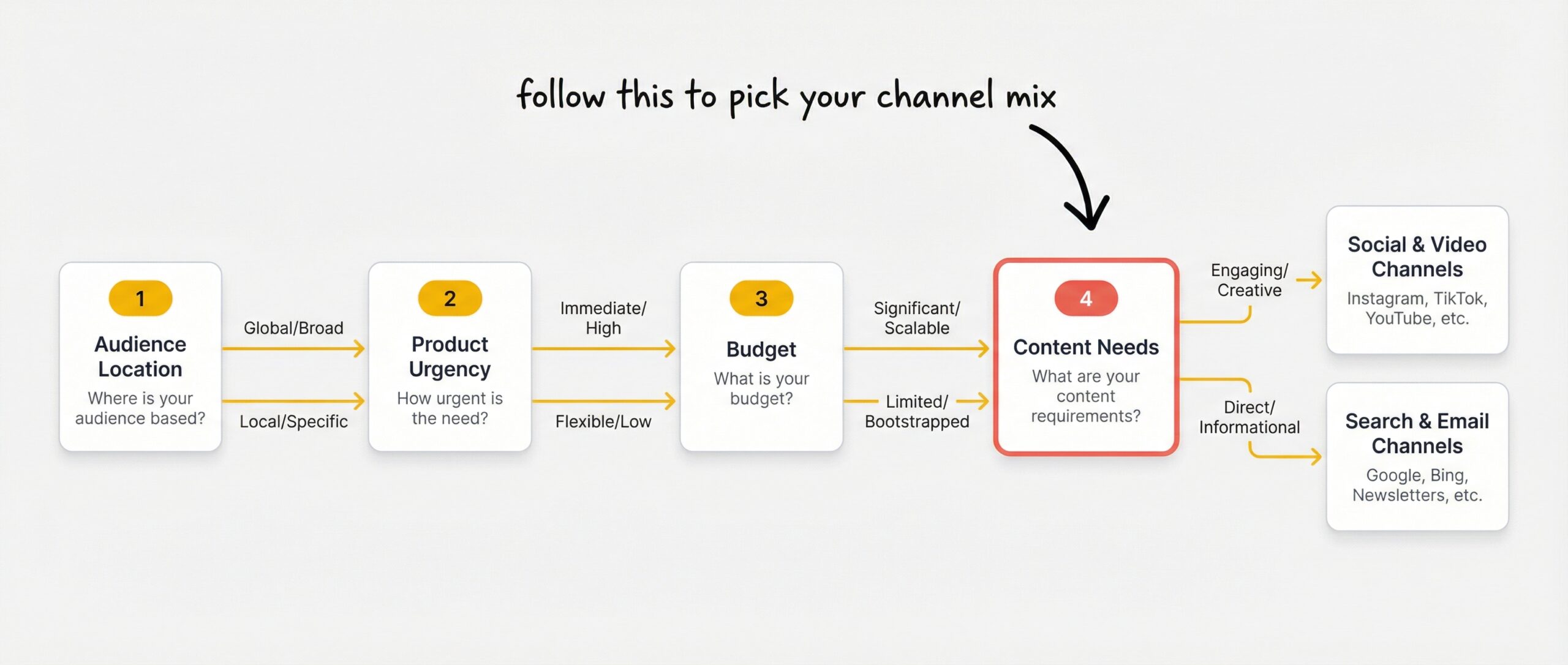
Instead of picking one channel and hoping for the best, use this four-factor framework. It’s the quickest way to make the WhatsApp vs SMS restock decision for your Shopify store based on real factors.
Factor 1: Where are your customers?
Factor 2: How urgent are your restocks?
Factor 3: What’s your budget?
Factor 4: How much product detail do customers need?
The short answer: yes, but with rules. Sending the same alert through email AND SMS AND WhatsApp simultaneously annoys customers. The multi-channel approach that works is letting customers pick their preferred channel and sending one alert per channel per restock.
The case for multi-channel: Different customers prefer different channels. A 25-year-old in Mumbai checks WhatsApp constantly but ignores email. A 45-year-old in Ohio reads SMS immediately but doesn’t use WhatsApp. Offering both means you meet each customer where they already are.
The case against: Over-notification kills engagement. If a customer gets the same “Product is back!” message on email, SMS, and WhatsApp within five minutes, they’ll unsubscribe from all three. One channel, one notification per restock, that’s the rule.
The practical approach for most Shopify stores: Use email as your baseline (it’s cheap and everyone has it), then add one high-engagement channel based on your audience geography. Let customers choose their preferred channel when they click the Notify Me button on your Shopify store. Track per-channel conversion rates and double down on what works.
Once you’ve picked your channel strategy, here’s the setup:
Step 1: Install a restock notification app. You need an app that captures customer signups and automates alerts across channels. StoreBeep restock notification app handles email alerts natively with custom templates and custom sender domains.
Step 2: Configure your email templates. Email should be your first channel. For step-by-step email setup, see our guide to automated restock emails on Shopify. Customize the subject line, preheader text, and design to match your brand.
Step 3: Add your second channel. Based on your decision framework, add SMS (for US-heavy audiences) or WhatsApp (for international audiences).
Step 4: Let customers choose. Your “Notify Me” form should let customers pick email, SMS, WhatsApp, or a combination. Don’t force a single channel.
Step 5: Track and optimize. Monitor conversion rates per channel, not just open rates. If SMS converts at 25% but costs 5x more than email per conversion, email might still win on ROI. Adjust your spending based on actual revenue recovered, not engagement metrics.
SMS and WhatsApp both achieve 98% open rates. Email averages 20% overall, but back-in-stock emails specifically reach 65% because customers who signed up already want the product. Open rate alone shouldn’t decide your channel, conversion rate and cost per conversion matter more.
It depends on your audience geography. SMS is better for US/Canada customers with 21-40% conversion rates and immediate delivery. WhatsApp is better for international stores with 45-60% CTR, richer media (images, buttons), and 3.2 billion global users.
Email costs $0.001-$0.03 per message. SMS costs $0.01-$0.05 per message in the US. WhatsApp marketing templates cost $0.02-$0.22 depending on the recipient’s country. At 1,000 alerts, email costs under $30, SMS costs $10-$50, and WhatsApp ranges from $20-$220.
Yes, and it’s recommended. Use email as your baseline, then add SMS or WhatsApp based on your audience. Let customers choose their preferred channel, and never send the same alert across all channels simultaneously, one notification per channel per restock avoids fatigue.
In the US, TCPA requires express written consent before sending SMS. Violations cost $500-$1,500 per unauthorized message per recipient. You must honor opt-outs within 24 hours, only send between 8 a. m. and 9 p. m., and keep records of every consent.
SMS leads with 21-40% conversion rates, followed by WhatsApp at 18-25% and email at 5-7%. However, email’s much lower cost often means the lowest cost per conversion, $0.20 per sale versus $0.12 for SMS and $0.40 for WhatsApp in typical scenarios.
No. Email should always be your baseline, it’s the cheapest channel and restock emails get 65% open rates (far above standard email). Add SMS or WhatsApp as a second channel for high-urgency restocks, but never eliminate email entirely.
SMS: 3 minutes on average. WhatsApp: 80% opened within 5 minutes. Email: hours to days. For limited-stock restocks where every minute counts, SMS and WhatsApp give you a significant speed advantage over email.
When you compare SMS vs email vs WhatsApp for restock alerts, no single channel is universally best. Email gives you the lowest cost and richest content. SMS gives you speed and immediacy. WhatsApp gives you the highest click-through rates and interactive buying experiences. The stores that recover the most revenue from stockouts use email as the foundation, add one high-engagement channel based on their audience, and let customers choose how they want to be notified. Pick your channels based on your data, not someone else’s benchmarks. If you’re still handling out of stock products on Shopify without any restock alert system, start with email, it’s free, fast to set up, and delivers 65% open rates on day one.
Keep reading