February 22, 2026 · Gaurav Radadiya
Klaviyo is one of the strongest email marketing platforms for Shopify. Its back in stock feature, though, has real gaps that cost you sales. A Klaviyo back in stock alternative is a dedicated Shopify app that handles restock notifications independently, offering channels, analytics, and customization that Klaviyo’s built-in flow can’t match.
Here’s why that matters: back in stock emails hit a 65.32% average open rate, higher than nearly every other email type (Barilliance email marketing benchmarks, 2024). When your restock notifications convert at 22.45% (MarketingSherpa, 2024), the tool you use to send them directly impacts how much revenue you recover.
Many Shopify merchants pay $20-350/month for Klaviyo and assume the built-in back in stock feature is good enough. It handles the basics, sure. But if you need WhatsApp alerts, custom sender domains, demand analytics, or compatibility with all Shopify themes, you’ll hit walls fast.
This article breaks down exactly where Klaviyo’s back in stock falls short, which dedicated apps fill those gaps, and whether you should replace Klaviyo’s feature or run both tools together.
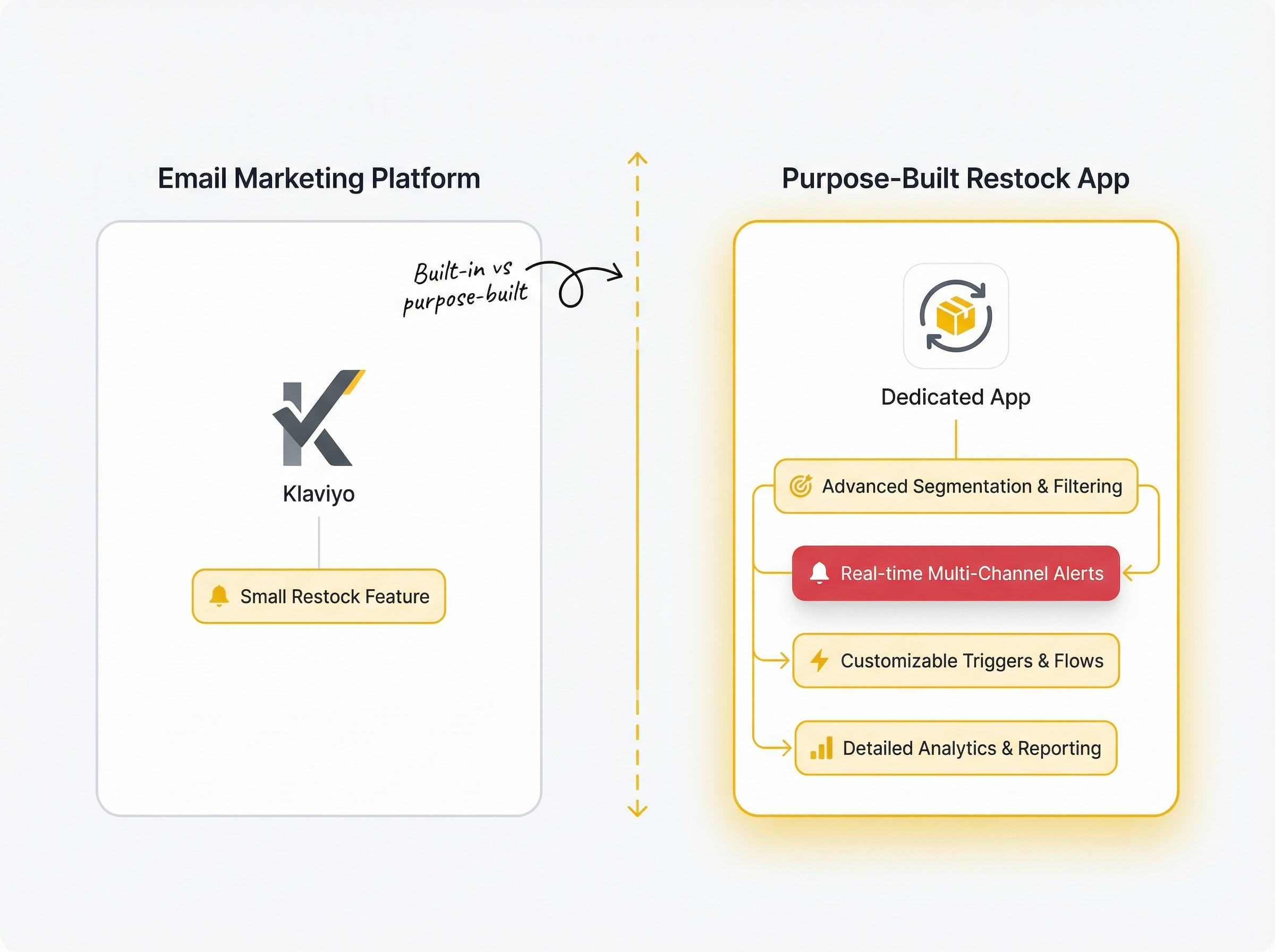
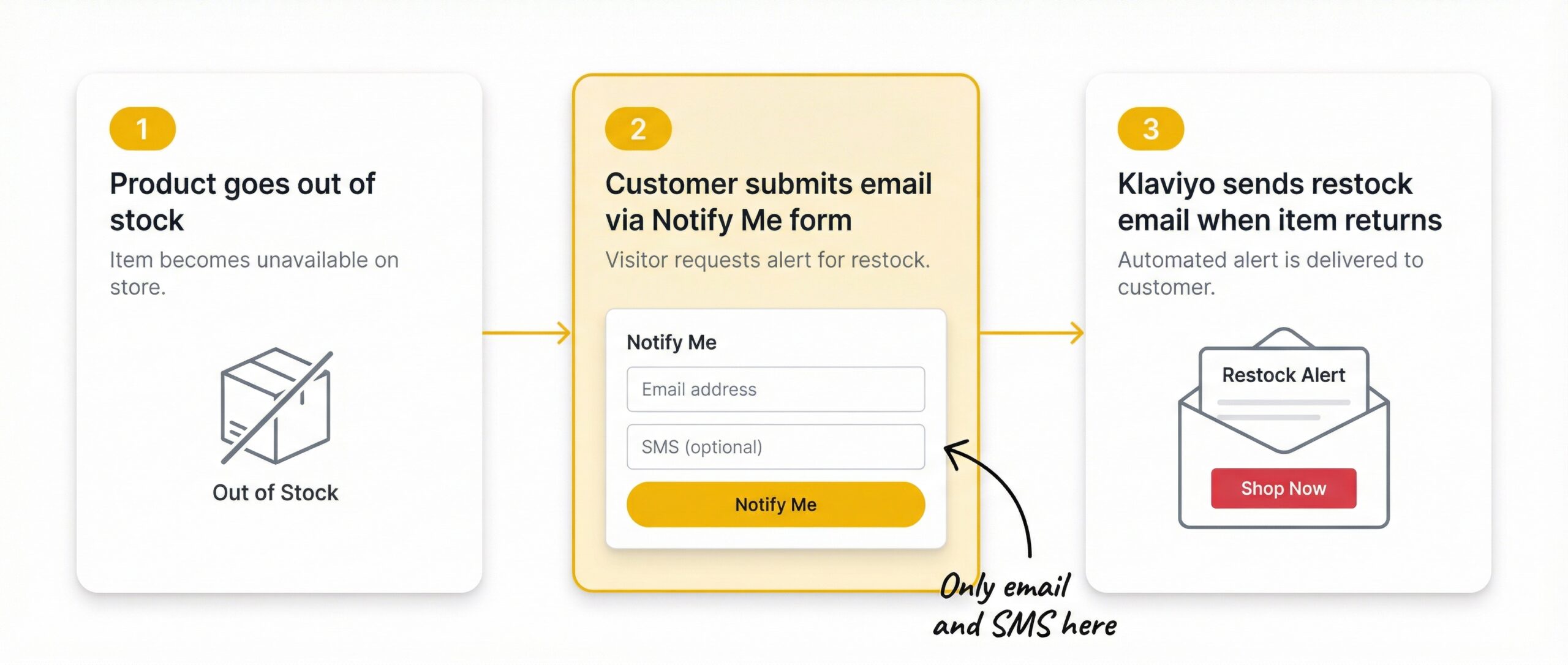
Klaviyo’s back in stock feature automatically displays a “Notify Me” button on out-of-stock Shopify product pages, collects email or SMS opt-ins, and sends automated restock alerts when inventory returns. It’s a built-in flow within the Klaviyo platform, not a standalone tool.
The process has three steps:
You can customize the form appearance, set batch notification strategies (sending alerts in waves rather than all at once), and connect the flow to your existing Klaviyo segments.
Klaviyo’s native back in stock covers the basics:
For stores that only need simple email-based restock alerts and already pay for Klaviyo, this works. The problems start when you need anything beyond that.
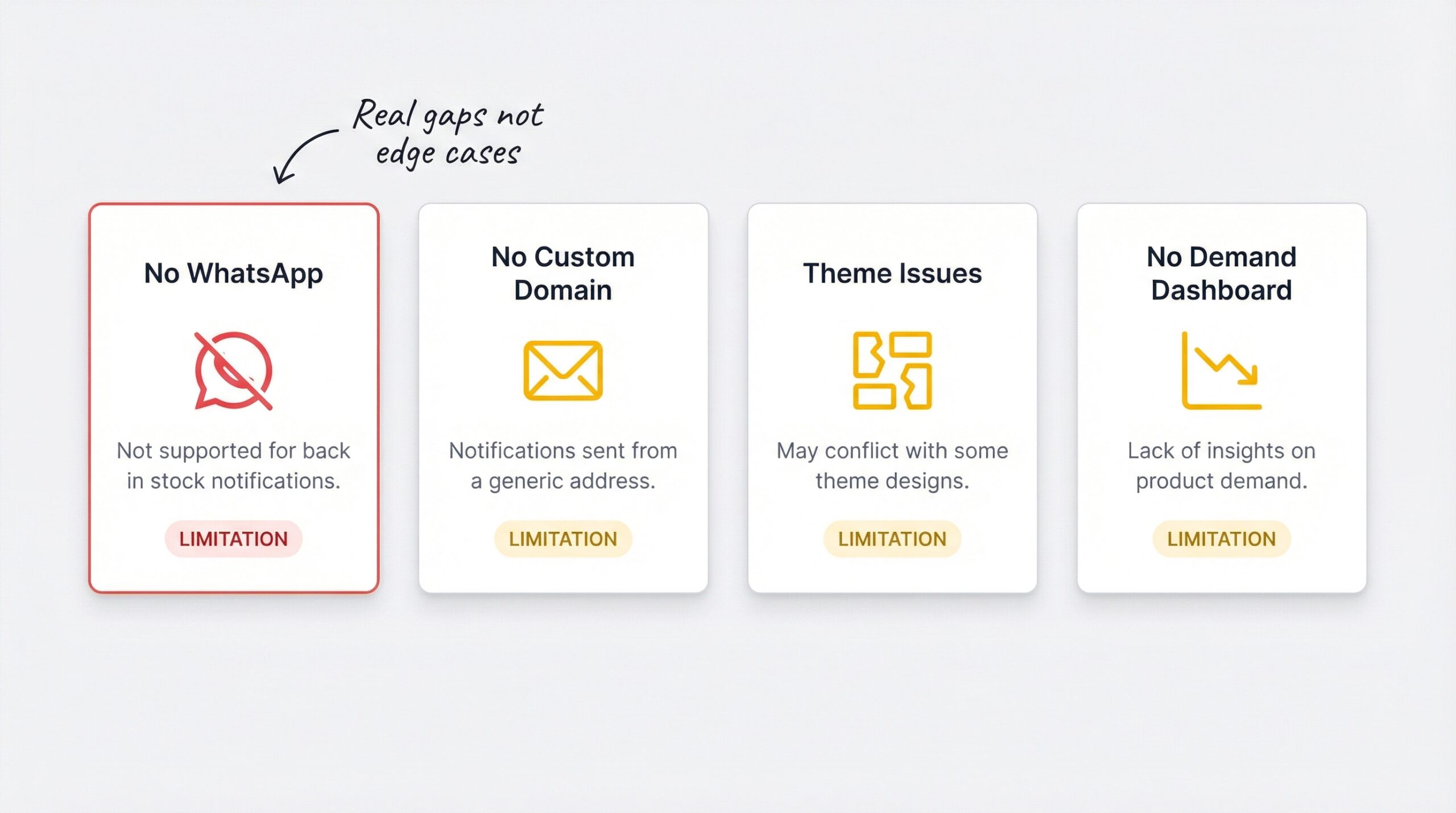
These Klaviyo back in stock limitations affect most Shopify stores: email and SMS only (no WhatsApp or push), no custom sender domains, limited demand analytics, and several Shopify-specific compatibility issues that dedicated apps solve.
This is the biggest gap. Our WhatsApp vs email comparison for Shopify notifications shows WhatsApp messages achieve a 98% open rate compared to roughly 20% for email (Wapikit, 2025). Push notifications deliver a 28% click rate versus 1-2% for email (PushEngage push notification benchmarks, 2025).
Klaviyo’s back in stock flow only sends via email and SMS. If you want to reach customers on WhatsApp, the channel where they actually read messages, you need a dedicated app. Check out our guide to WhatsApp back in stock alerts on Shopify for a full breakdown of how WhatsApp restock notifications work.
With Klaviyo’s back in stock, your restock alerts don’t come from your brand’s email domain. Customers see a generic sender, which reduces recognition and open rates. Dedicated apps like StoreBeep let you send from your own verified domain (e. g, [email protected]) on the Pro plan, making emails look professional and improving deliverability.
Klaviyo tracks flow revenue at the flow level, but doesn’t provide a dedicated demand dashboard showing which out-of-stock products have the highest waitlists. There’s no alert-to-purchase conversion tracking either. You can’t answer “which product should I restock first?” or “how many alert recipients actually bought?” without manual data work.
Klaviyo’s back in stock feature has several Shopify-specific limitations:
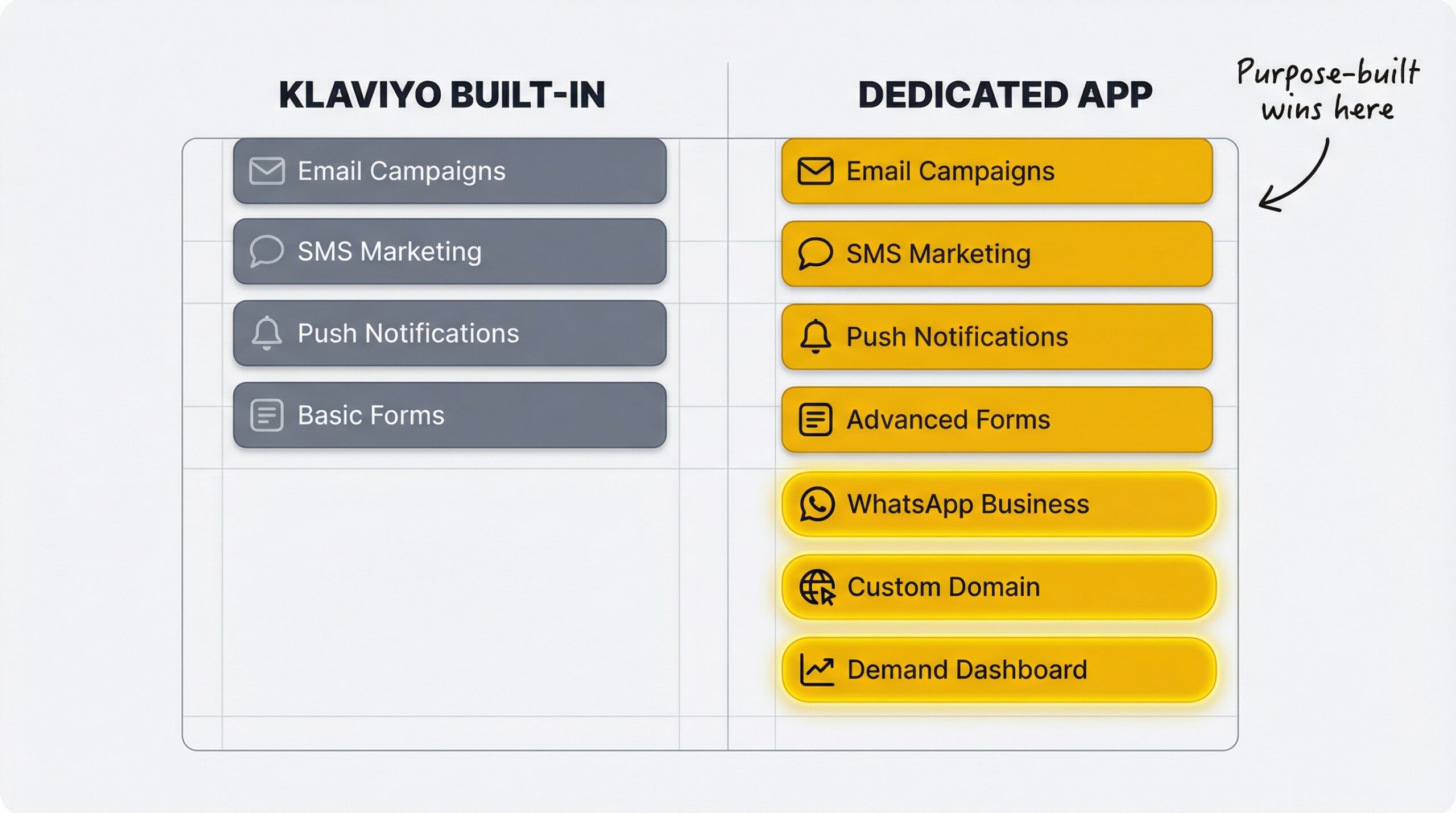
When you compare a dedicated back in stock app vs Klaviyo, the feature gap becomes clear. Dedicated restock notification apps are purpose-built for this exact job. Here’s the full feature comparison:
| Feature | Klaviyo built-in | Dedicated apps |
|---|---|---|
| Email alerts | Yes | Yes |
| SMS alerts | Yes | Some apps |
| WhatsApp collection | No | StoreBeep, Notify! |
| Push notifications | No | Notify! |
| Custom sender domain | No | StoreBeep |
| Purchase tracking | No | StoreBeep, Swym |
| Demand dashboard | No | StoreBeep, Swym |
| Works with all themes | Free themes only | All themes |
| Multi-location support | No | Some apps |
| Setup complexity | Flow building required | Auto-setup |
| Cost for back in stock | $20-350/mo (platform) | $0-30/mo |
Restock automation emails already hit a 58.03% open rate with a 21.19% click rate (Omnisend email marketing benchmarks, 2025). A dedicated app with multi-channel collection, better deliverability through custom domains, and demand analytics pushes those numbers even higher.
For a deeper comparison of all the top options, see our roundup of the best Shopify restock notification apps with real pricing.
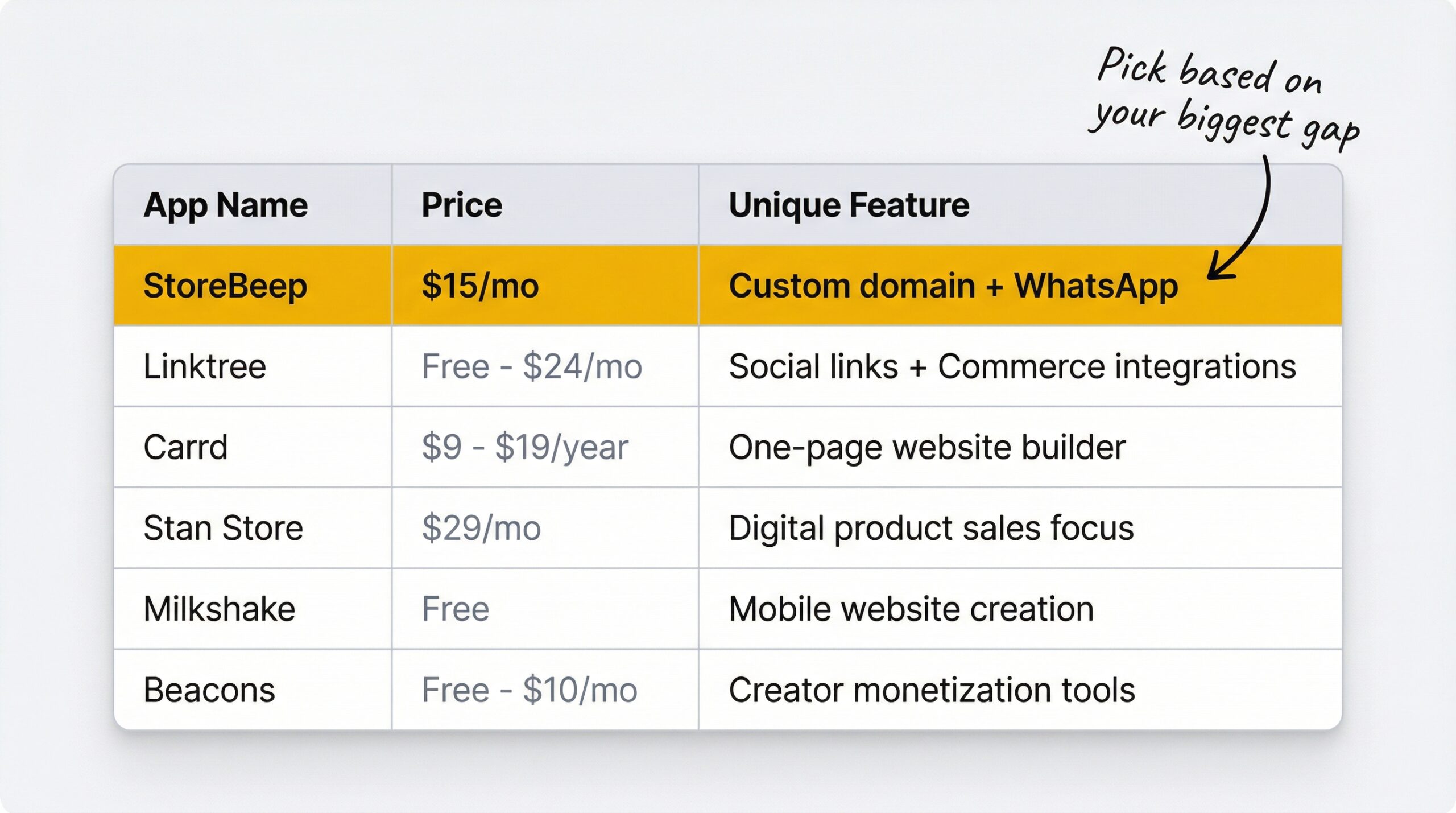
Five dedicated apps stand out as strong Klaviyo back in stock alternatives for Shopify. Each one fills specific gaps in Klaviyo’s built-in feature.
| App | Rating | Price | Channels | Klaviyo integration | Best for |
|---|---|---|---|---|---|
| StoreBeep | 5.0 | Free (50 emails/mo) | Email, WhatsApp | CSV/webhook | Multi-channel + custom domain |
| Swym | 4.8 | Free (limited) | Email, SMS | Direct integration | Klaviyo-native users |
| Notify! | 5.0 | Free (limited) | Email, SMS, push, WhatsApp | No | Widest channel coverage |
| Appikon | 4.6 | Free (limited) | Email, SMS | Direct integration | Klaviyo flow integration |
| STOQ | 5.0 | Free (limited) | Email, SMS | No | Preorder + restock combo |
StoreBeep restock notification app is a purpose-built back in stock alert tool that collects both email and WhatsApp opt-ins from a single “Notify Me” form. It’s the only app in this group with a custom sender domain on its Pro plan ($9.99/month), letting restock emails come from your own brand’s email address.
StoreBeep also includes purchase tracking and a demand dashboard, so you can see which products have the highest waitlist signups and how many alert recipients actually buy. It connects to Klaviyo (and any other email platform) through CSV export and webhooks.
Swym has the deepest direct Klaviyo integration of any back in stock app. Subscriber data syncs directly into Klaviyo flows and segments, making it a natural fit for stores that want to keep Klaviyo as the notification sender. The trade-off: no WhatsApp support and no custom sender domain.
Notify! covers the most notification channels, including email, SMS, push notifications, and WhatsApp. If sheer channel breadth is your priority, Notify! is worth evaluating. It doesn’t integrate directly with Klaviyo, so you’d run it independently.
Appikon offers a direct Klaviyo connector that pipes subscriber data into Klaviyo flows. It’s designed for merchants who want to keep Klaviyo as their notification engine but need better collection forms and theme compatibility than Klaviyo’s built-in feature provides.
STOQ combines preorder functionality with back in stock alerts. If you sell products that regularly go out of stock and want to offer preorders on the same page where you collect restock signups, STOQ handles both. No direct Klaviyo integration, but it exports data via CSV.
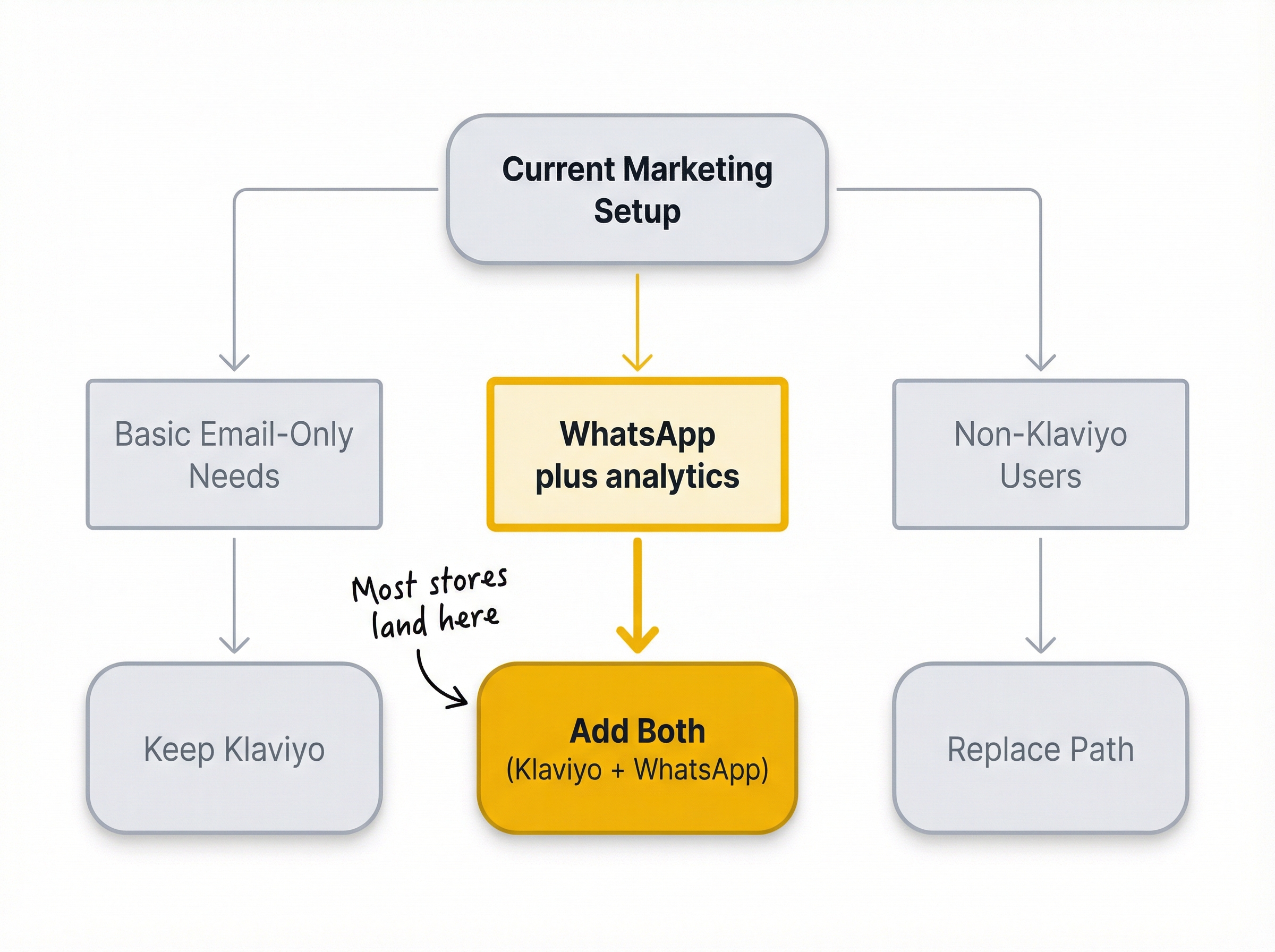
Most merchants get the best results by using a dedicated back in stock app for collection and notification alongside Klaviyo for broader email marketing, not replacing one with the other.
Here’s a decision framework:
| Scenario | Recommendation | Why |
|---|---|---|
| You only need email alerts and already pay for Klaviyo | Keep Klaviyo’s built-in | No point adding another tool |
| You want WhatsApp or custom sender domain | Add a dedicated app | Klaviyo can’t do this |
| You need demand dashboards and purchase tracking | Add a dedicated app | Klaviyo’s analytics are limited here |
| You don’t use Klaviyo for email marketing | Use a dedicated app only | No reason to pay for Klaviyo |
| Your theme breaks Klaviyo’s form | Switch to a dedicated app | Dedicated apps work with all themes |
Klaviyo’s built-in back in stock makes sense if your subscriber list is under 500 profiles, you use a free Shopify theme, and you only need email or SMS alerts. In that case, Klaviyo’s free plan handles restock notifications without additional cost or tools.
This is the most common scenario. You already use Klaviyo for email marketing (abandoned carts, welcome flows, newsletters) and want better restock notification features without dropping your email platform.
If you want to set up automated restock emails on Shopify with a dedicated app and sync that data back to Klaviyo, you can do so through CSV exports, webhooks, or direct integrations (Swym, Appikon).
If you use a different email platform like Omnisend, Mailchimp, or Drip, there’s no reason to add Klaviyo just for back in stock. Using a back in stock app instead of Klaviyo costs less and offers more restock-specific features. Even merchants who don’t use any email platform can run a standalone app to handle out-of-stock products on Shopify and capture demand data independently.
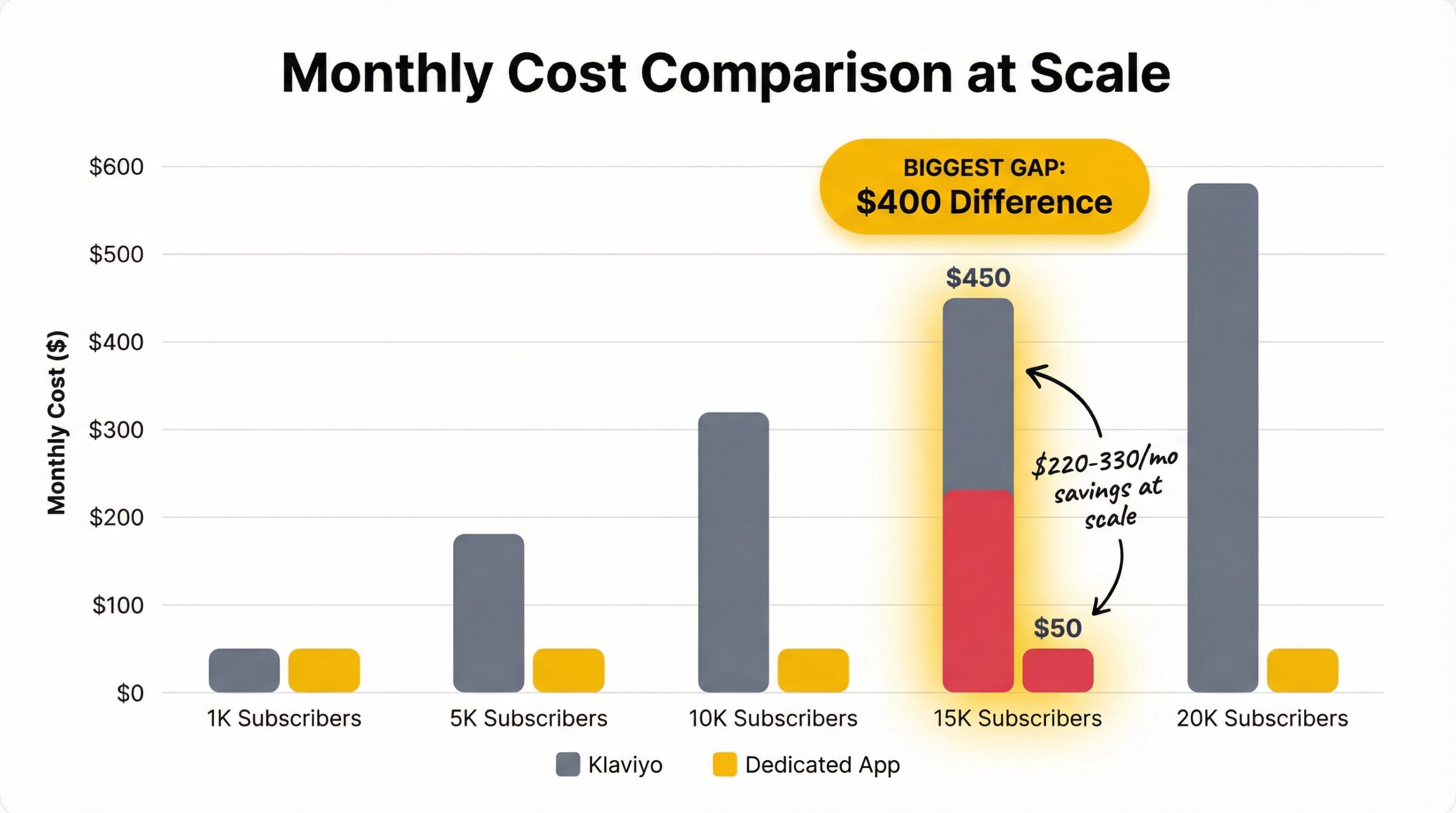
This is where the math gets interesting. Klaviyo charges based on your total active profile count, not just restock subscribers. Every “Notify Me” signup adds to your billable profile count.
| Subscriber count | Klaviyo cost/mo | Dedicated app cost/mo | Monthly savings |
|---|---|---|---|
| 0-250 | Free | Free | $0 |
| 500 | $20 | $0-10 | $10-20 |
| 2,500 | $60 | $10-20 | $40-50 |
| 10,000 | $150 | $20-30 | $120-130 |
| 15,000 | $250-350 | $20-30 | $220-330 |
A Shopify store with 15,000 email subscribers pays $250-350/month for Klaviyo (EmailToolTester, 2026). If a significant portion of those profiles came from back in stock signups, you’re paying enterprise-level pricing for what a $10-30/month app handles with more features.
The signup conversion rate for back in stock forms averages 6.46% (Omnisend, 2025). On a store with decent traffic to out-of-stock pages, that adds up to hundreds or thousands of new profiles per month, all counting toward your Klaviyo bill.
Active profiles from back in stock signups count toward Klaviyo billing whether or not you send marketing emails to those people. If someone signs up for a restock alert and never opens another email from you, they still occupy a paid profile slot.
With a dedicated app, restock subscribers exist in the app’s own system. They don’t inflate your email platform costs. You can still sync high-intent buyers back to Klaviyo after they purchase, keeping your Klaviyo list focused on engaged subscribers.
If you’re budget-conscious, see our comparison of free back in stock apps on Shopify that handle restock alerts without any monthly cost.
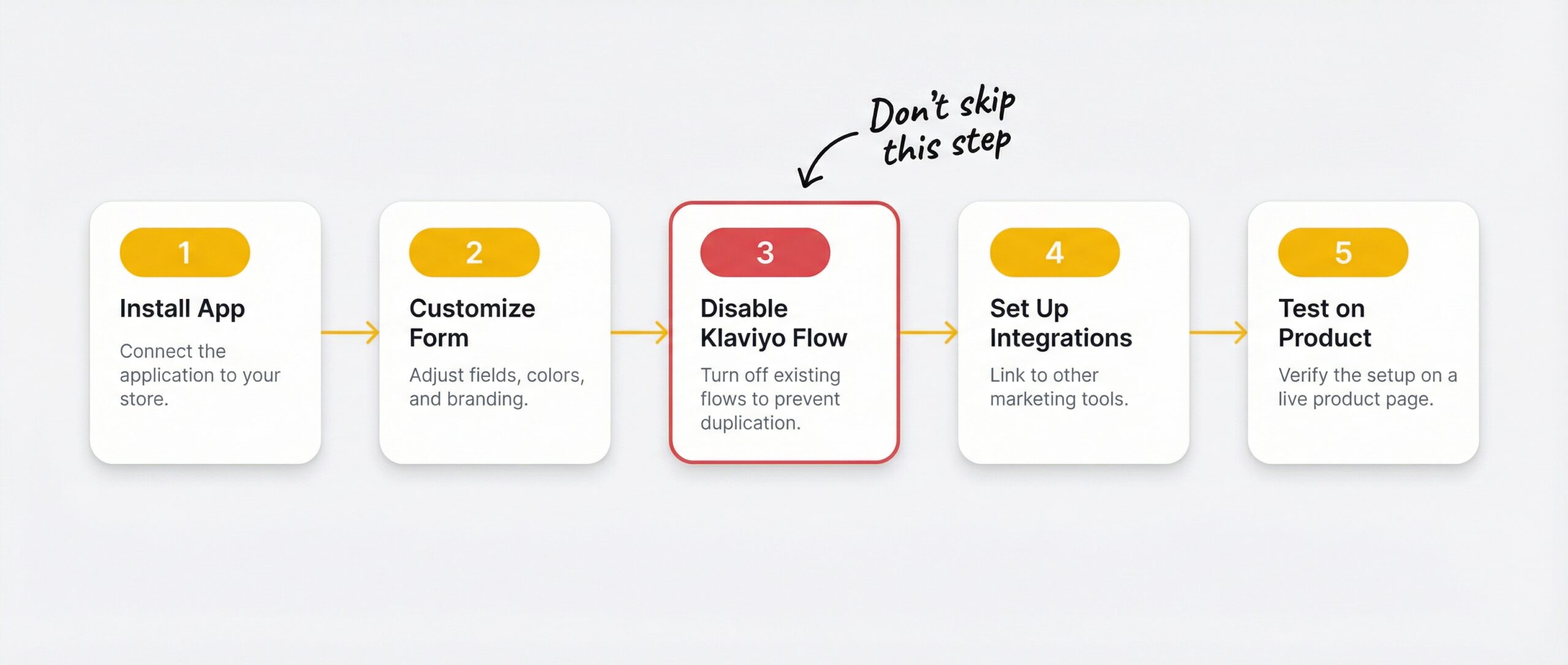
Switching to a Klaviyo restock notification alternative takes less than 10 minutes. Here’s what’s involved:
No code changes, no developer needed. For a step-by-step walkthrough, see our guide on how to add a notify me button on Shopify.
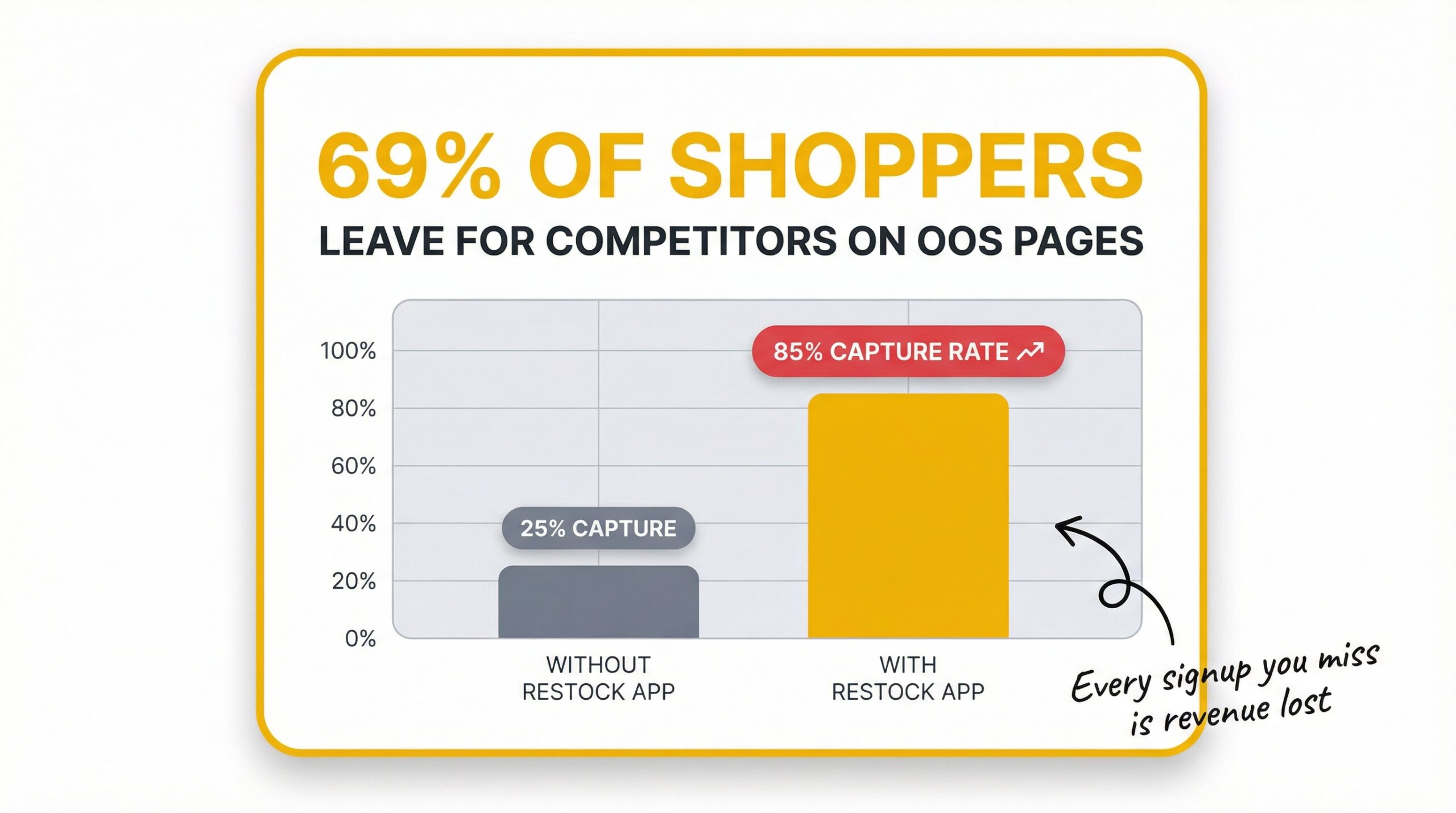
The impact on your recovered revenue can be significant. 69% of shoppers leave to buy from a competitor when they encounter an out-of-stock page (Opensend stock-out rate statistics, 2025). A better notification tool means you capture more of those shoppers and bring them back.
StoreBeep, Swym, and Notify! are the top alternatives. StoreBeep offers WhatsApp collection and custom sender domains, Swym integrates directly with Klaviyo flows, and Notify! covers the most notification channels including push.
No, Klaviyo’s built-in back in stock flow only supports email and SMS notifications. For WhatsApp restock alerts, you need a dedicated app like StoreBeep or Notify!.
Yes, most dedicated back in stock apps work alongside Klaviyo without conflicts. Swym and Appikon offer direct Klaviyo integration, while StoreBeep connects via CSV export and webhooks.
For stores primarily needing back in stock alerts, Klaviyo’s pricing is hard to justify. The platform costs $20-350/month depending on subscriber count, while dedicated apps cost $0-30/month for the same back in stock functionality with additional features.
Klaviyo’s back in stock form won’t display if you’ve enabled Shopify’s “Continue selling when out of stock” setting. It also only works reliably on free Shopify themes. If either applies, switch to a dedicated app.
Klaviyo offers domain authentication for its platform broadly, but doesn’t provide a dedicated custom sender domain specifically for back in stock notifications the way apps like StoreBeep do on their Pro plan ($9.99/month).
Swym and Appikon offer the deepest direct Klaviyo integration, syncing subscriber data into Klaviyo flows and segments automatically. StoreBeep connects via webhooks and CSV export, which works with any email platform.
Klaviyo tracks flow revenue at the flow level but doesn’t offer a dedicated demand dashboard or alert-to-purchase tracking the way StoreBeep and Swym do with purpose-built analytics.
Not for restock notifications. A dedicated app handles collection and sending independently. You may still want Klaviyo for broader email marketing, but it’s not required for back in stock alerts.
Swym and Appikon sync directly with Klaviyo. With other apps like StoreBeep, export subscriber data via CSV and import into Klaviyo, or use webhook integrations to push data into Klaviyo automatically.
Klaviyo earns its reputation as a top email marketing platform. But its back in stock feature is a secondary add-on, not a dedicated tool. It lacks WhatsApp support, custom sender domains, demand analytics, and reliable compatibility across all Shopify themes.
Here’s what to take away:
The right Klaviyo back in stock alternative for your Shopify store depends on which gaps matter most. Install a dedicated app, disable Klaviyo’s built-in flow to avoid duplicates, and let each tool do what it’s built for. Your restock alerts will reach more customers, through more channels, from a sender they actually recognize.
Try StoreBeep restock notification app free and see how much revenue your restock alerts can recover.
Keep reading