February 20, 2026 · Gaurav Radadiya
Every app listing on Shopify says “free plan available.” But what does that free plan actually give you? Usually 10 to 50 emails per month, the app’s branding on your notifications, and no analytics to speak of.
A free back in stock app for Shopify adds a “Notify Me” button to out-of-stock product pages and sends automated restock email alerts to subscribed customers at no monthly cost. The catch is that every free plan comes with limits. Back in stock emails hit a 65.32% average open rate, the highest of any email type (Barilliance email marketing research, 2024). That means even a limited free plan can recover real revenue if you pick the right one.
This guide breaks down every free back in stock app on Shopify as of February 2026, compares what each free plan actually includes, and helps you figure out whether free is enough for your store.
Free back in stock apps are Shopify applications that let merchants add a “Notify Me” button to out-of-stock product pages and send automated restock email alerts to subscribed customers at no monthly cost, though most limit the number of emails you can send. 91% of consumers won’t wait for out-of-stock items and will shop elsewhere (Adobe Commerce, 2024). A restock alert app captures those customers before they leave.
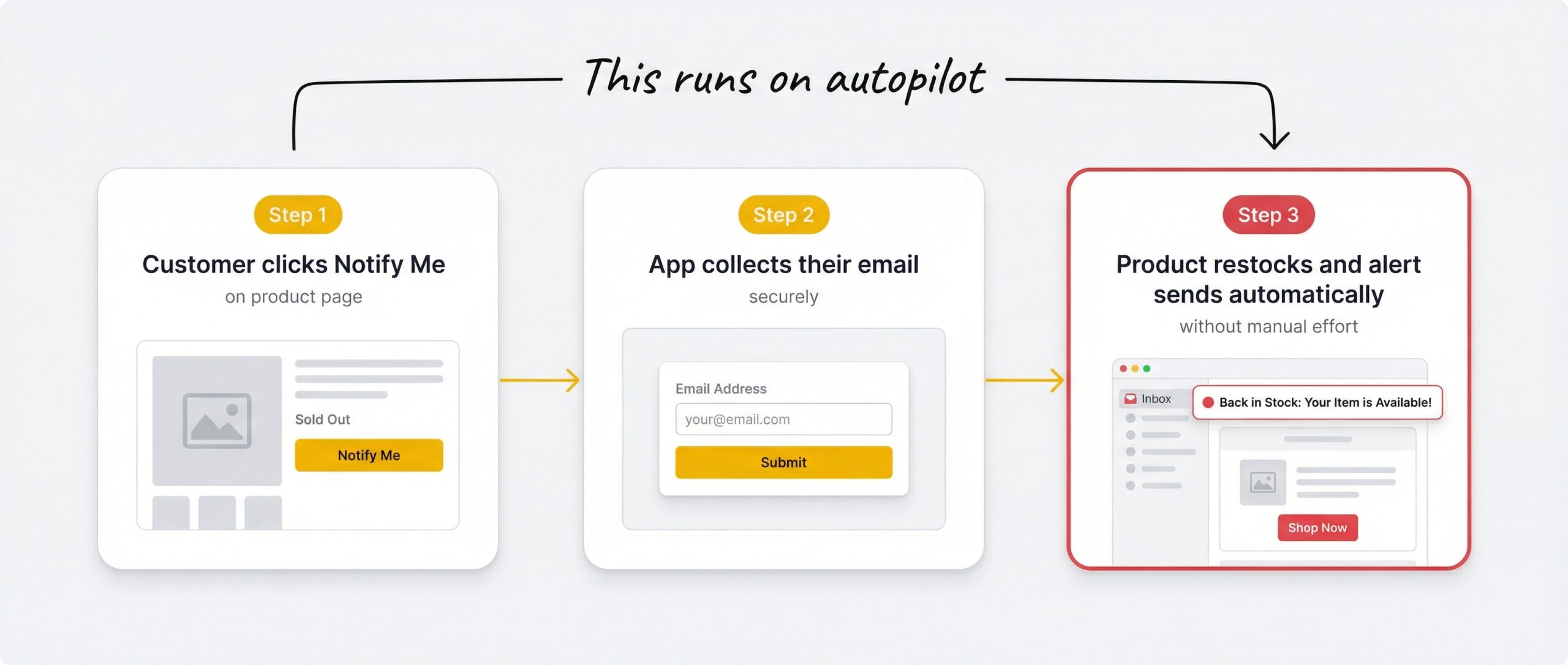
When a product goes out of stock, the app replaces the “Add to Cart” button with a “Notify Me” option. Customers enter their email, and when you restock, they get an automatic notification. If you’ve never set one up before, our guide on how to add a Notify Me button on Shopify walks through the full process in about five minutes.
The process is straightforward:
No manual follow-ups. No copying emails into spreadsheets. The entire cycle runs on autopilot once you install the app. For a deeper look at how the full notification pipeline works across Shopify, see our breakdown of Shopify notification systems and how they recover revenue.
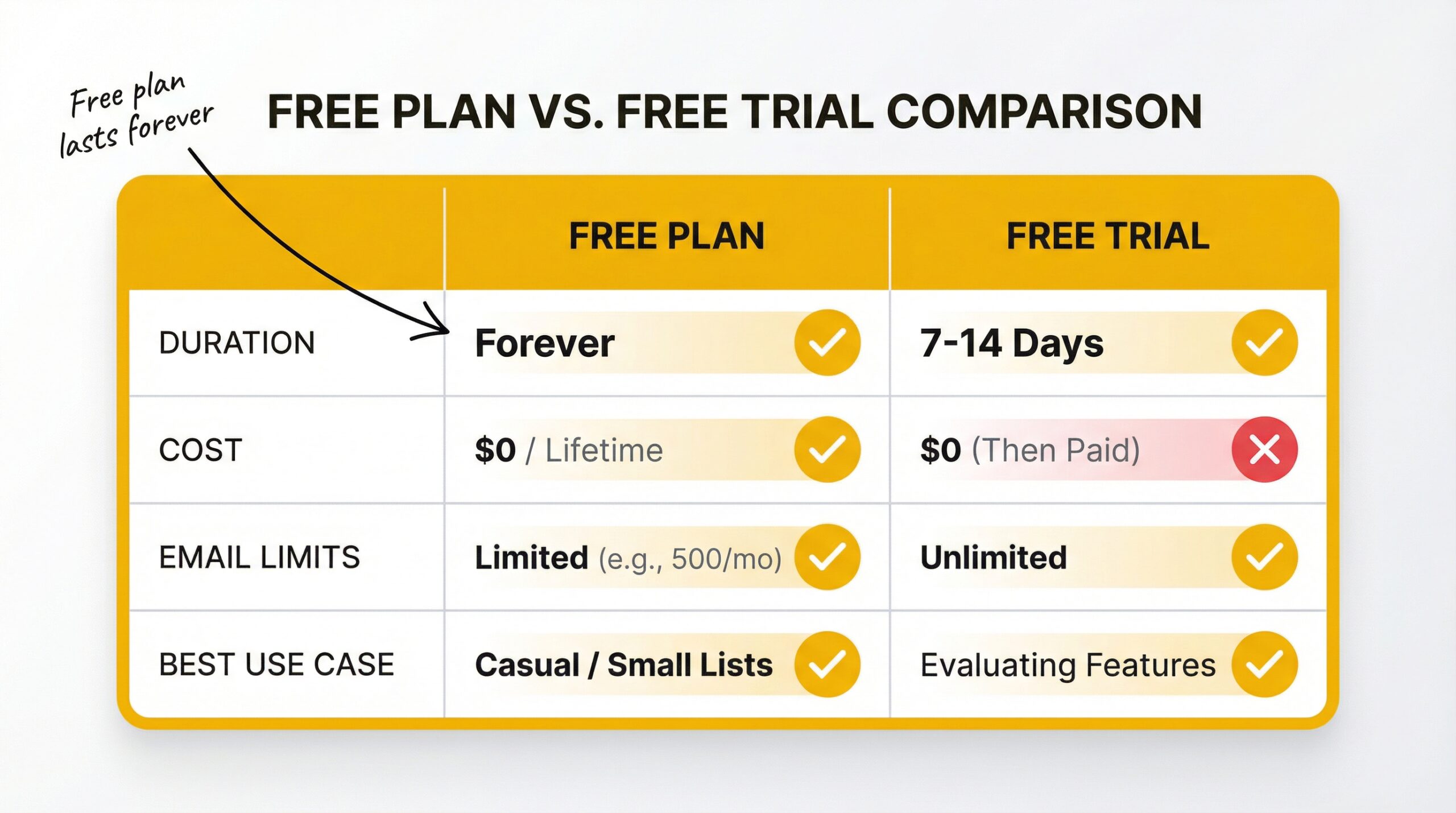
This is where most comparison articles fall short. Some apps advertise a “free plan,” while others offer a “free trial.” These are not the same thing.
| Free plan | Free trial | |
|---|---|---|
| Duration | Forever | 7-14 days |
| Cost after period ends | $0 (within limits) | Must pay or lose access |
| Email limits | 10-50 per month | Unlimited during trial |
| Best for | Testing and small stores | Evaluating premium features |
A free plan keeps working indefinitely within its limits. A free trial gives you full access for a short window, then cuts you off unless you pay. Every app in this guide offers a genuine free plan, not just a trial.
Here is every Shopify back in stock app with a genuine free plan as of February 2026, compared side by side.
| App | Free plan limit | Channels | Remove branding? | Rating | Best for |
|---|---|---|---|---|---|
| StoreBeep | 50 emails/mo | Email + WhatsApp collection | Paid plan | 5.0 | Multi-channel + custom domain |
| STOQ | Limited | Email, SMS | Paid plan | 5.0 | Preorder + restock combo |
| Notify! | Limited | Email, SMS, Push, WhatsApp | Paid plan | 5.0 | Multi-channel breadth |
| Appikon | Limited | Email, SMS | Paid plan | 4.6 | Klaviyo integration |
| SC Back in Stock | Limited | Email, SMS | Paid plan | 4.6 | Simple email alerts |
| Alert Me! | 10 alerts/mo | Paid plan | 4.8 | Bare minimum testing | |
| Back in Stock Duck | Limited | Email, WhatsApp | Paid plan | 5.0 | WhatsApp waitlists |
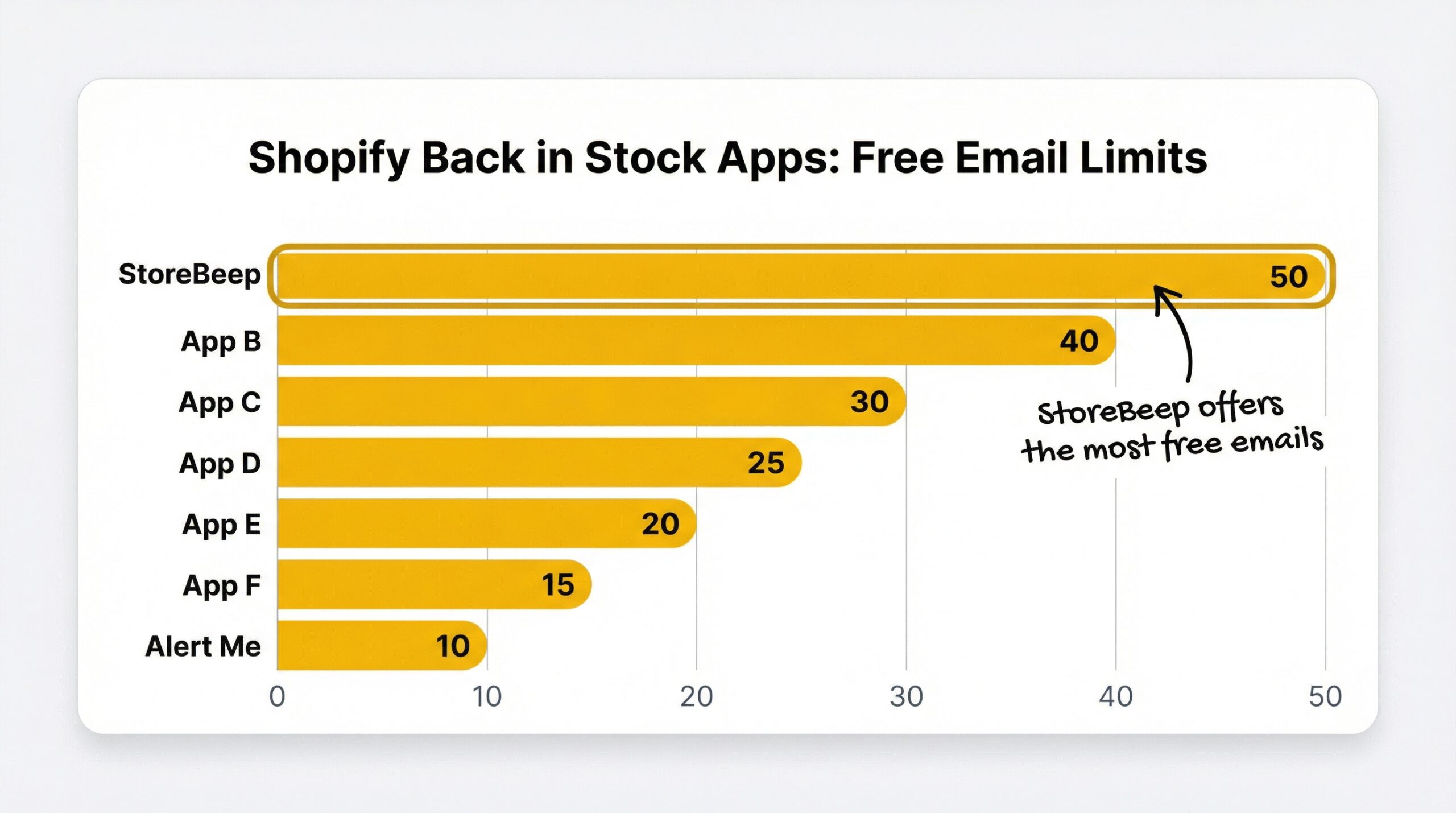
StoreBeep’s free plan gives you 50 emails per month with automatic “Notify Me” button placement on out-of-stock products. It stands out for collecting WhatsApp opt-ins alongside email signups even on the free tier, so you’re building a multi-channel subscriber list from day one. The main limitation is that WhatsApp sending and custom sender domain require the Pro plan ($9.99/month). Best for stores that want to start free but grow into multi-channel alerts.
STOQ bundles preorder functionality with back in stock alerts, which makes it useful if you sell both pre-launch and restocked products. The free plan has limited email sends and includes the app’s branding. It works well for stores that handle both preorders and regular stockouts in one tool.
Notify! offers the widest channel support on paper, including email, SMS, push notifications, and WhatsApp. On the free plan, most of these channels are heavily restricted or unavailable. Worth testing if multi-channel is a priority, but expect to upgrade for full functionality.
Appikon integrates directly with Klaviyo, which sets it apart from most back in stock apps. If your store already runs email marketing through Klaviyo, Appikon’s subscriber data flows into your existing workflows. The free plan has limited sends and includes app branding.
SC Back in Stock focuses on straightforward email notifications with a clean interface. The free plan covers basic email alerts with limited sends. A solid choice if you want simple, no-frills restock emails without extra features.
Alert Me! offers the most restrictive free plan at just 10 alerts per month. For stores testing whether back in stock alerts work at all, this is enough for a proof of concept. You’ll outgrow it quickly if more than a handful of customers sign up.
Back in Stock Duck emphasizes WhatsApp waitlist functionality, which makes it interesting for stores in markets where WhatsApp dominates (India, Brazil, parts of Europe). The free plan includes basic email and WhatsApp alerts with volume restrictions.
Every free back in stock app on Shopify restricts at least one of these four things: email volume, sender branding, notification channels, or analytics access. Understanding these gaps helps you decide whether free is enough or whether you’ll need to upgrade sooner than you think.
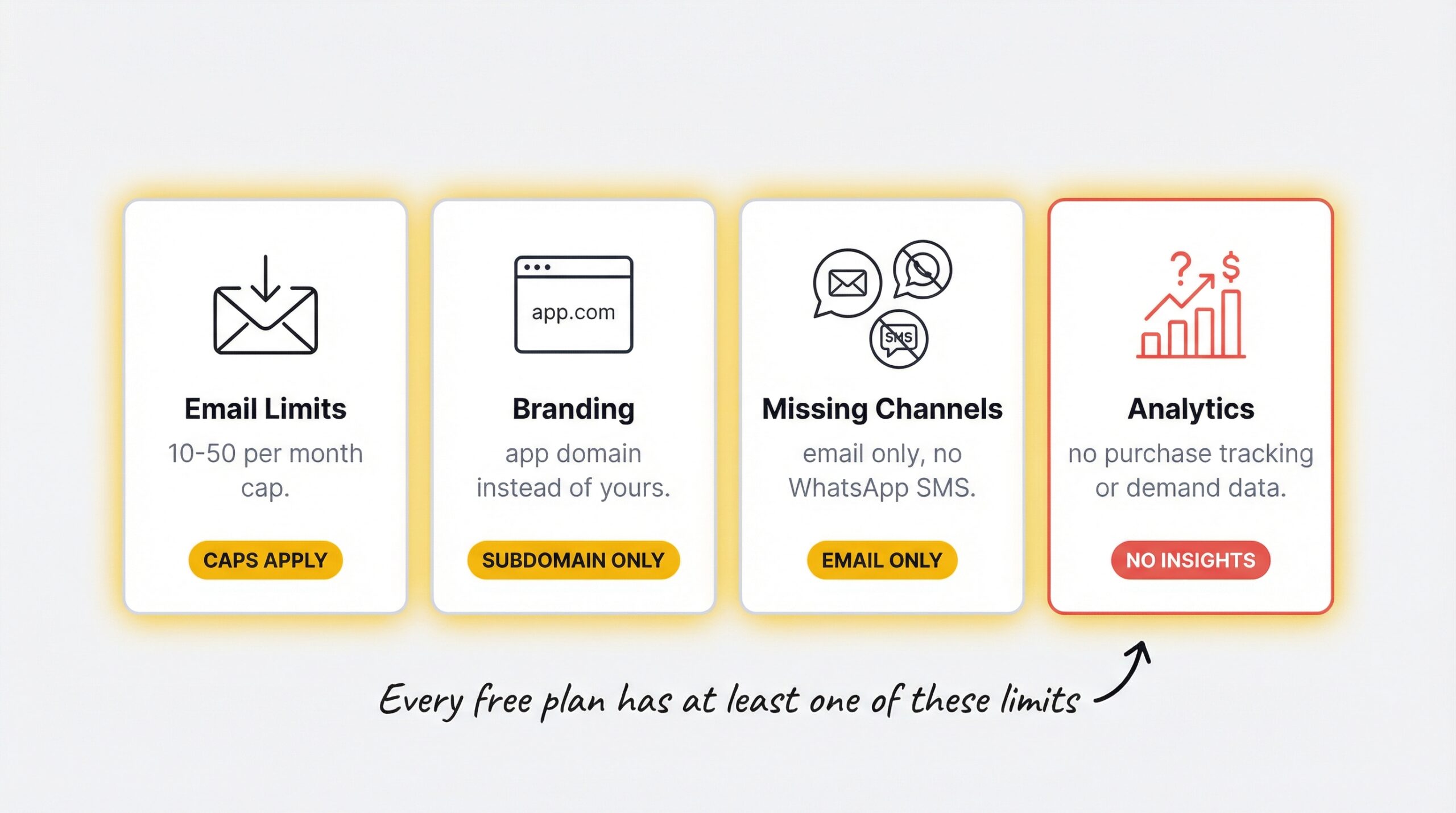
Most free plans cap at 10 to 50 emails per month. Once you hit the limit, subscribers who signed up won’t get notified until next month’s cycle resets. According to Omnisend email marketing automation benchmarks, back in stock signups convert at 6.46%, the highest of any automation type (Omnisend, 2025). Every unsent alert is a sale you’re leaving behind.
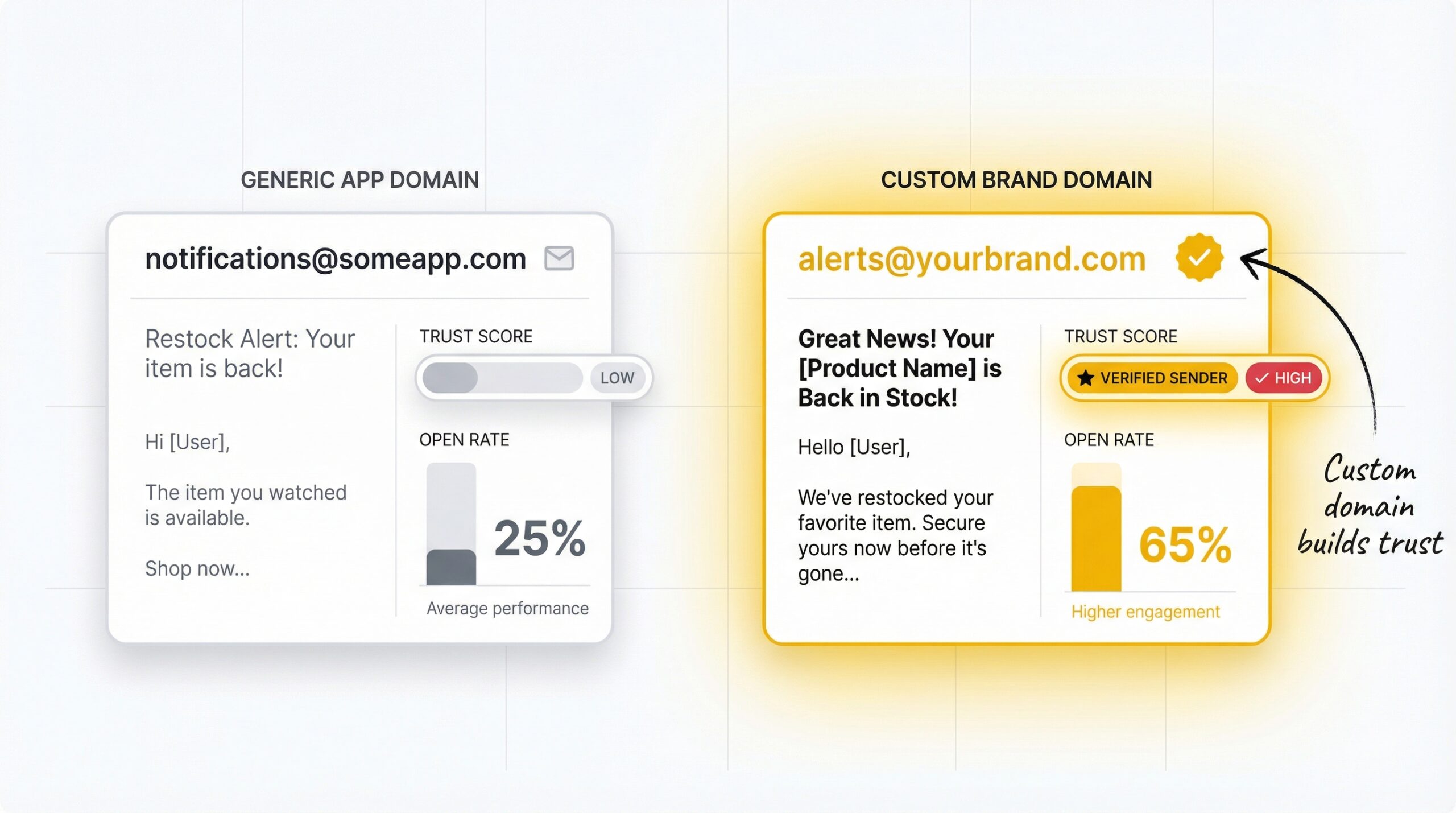
Free plans send emails from the app’s own domain. Your customer sees “[email protected]” instead of your brand name. That unfamiliar sender means lower open rates and more emails landing in spam.
Custom sender domains, where alerts come from something like [email protected], are paid features across every app listed above. For context, our guide on setting up automated restock emails on Shopify covers how sender domain affects deliverability in detail.
Most free tiers are email-only. WhatsApp messages achieve a 98% open rate compared to roughly 20% for email (Wapikit, 2025). That’s a massive gap if your customers prefer messaging apps over their inbox. For a closer look at the WhatsApp channel specifically, see our guide on WhatsApp back in stock alerts on Shopify.
| Limitation | Impact | Workaround on free plan |
|---|---|---|
| Email cap (10-50/mo) | Subscribers miss alerts after limit | Prioritize high-value products |
| App branding on emails | Lower trust, lower open rates | Accept until upgrade makes sense |
| No SMS/WhatsApp sending | Miss 98% open rate channel | Collect opt-ins for later use |
| No purchase tracking | Can’t measure ROI | Track manually via Shopify orders |
| No demand insights | Can’t prioritize restocking | Check subscriber counts manually |
Free plans rarely include purchase tracking, which means you can’t see whether your restock alert actually led to a sale. Without demand insights, you also can’t tell which out-of-stock products have the highest waitlist. You’re essentially guessing. If measuring ROI matters to you, this is usually the first reason to upgrade.
Yes. Even a free back in stock app can recover meaningful revenue because back in stock emails achieve a 22.45% conversion rate, far above the 2.5 to 3% ecommerce average (MarketingSherpa conversion optimization research, 2024; BlendCommerce, 2026). The math works even with tight volume limits.
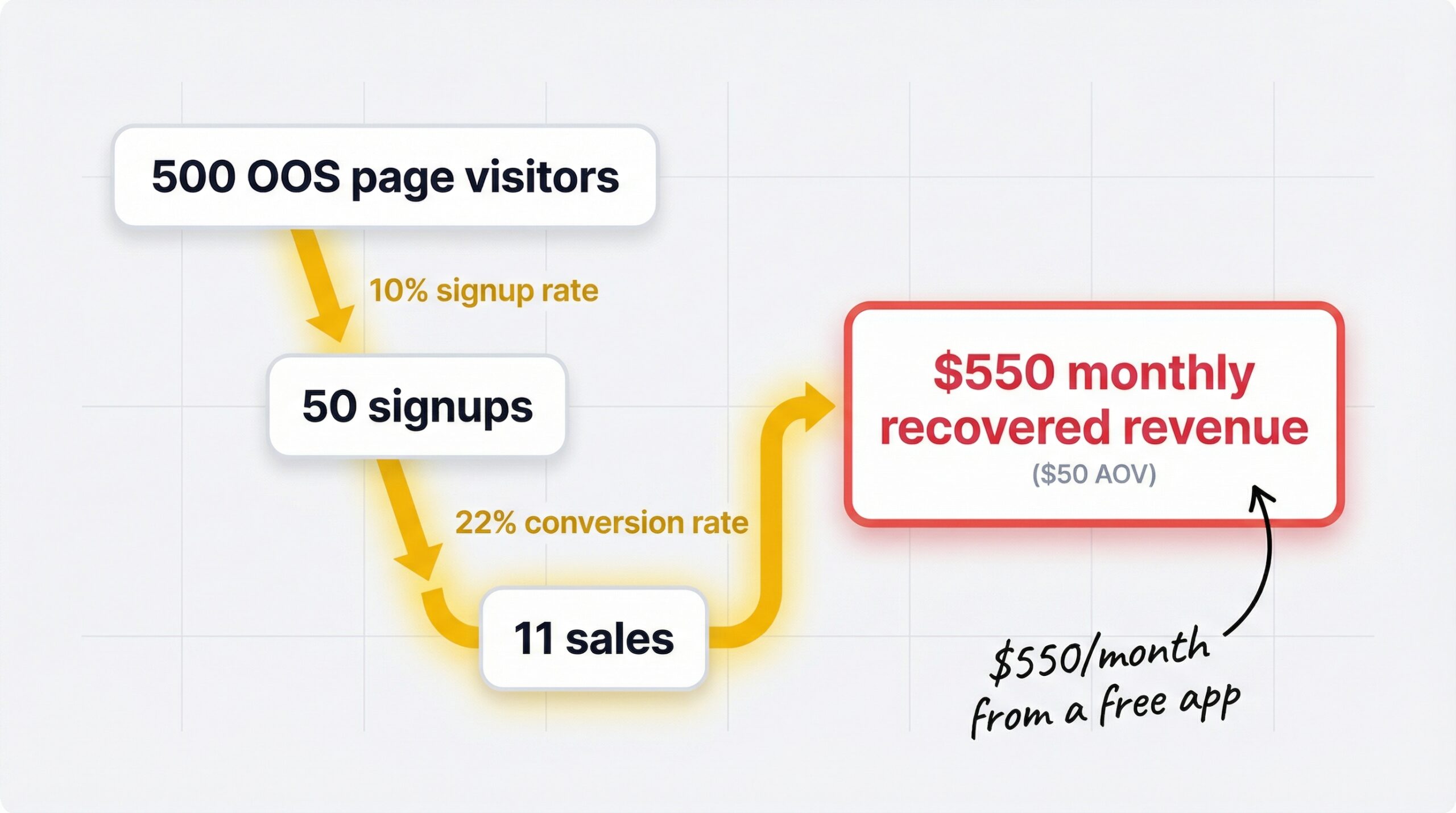
Here’s a realistic scenario for a store using a free plan with 50 emails per month:
| Metric | Value |
|---|---|
| Monthly visitors to OOS pages | 500 |
| Signup rate | 10% |
| Monthly signups | 50 |
| Conversion rate on alert email | 22% |
| Recovered sales | 11 |
| Average order value | $50 |
| Monthly recovered revenue | $550 |
| Annual recovered revenue | $6,600 |
That’s $6,600 per year from an app that costs nothing. To understand the full picture of what you lose without any restock alerts at all, check out what stockouts actually cost your Shopify store.
For broader context, $1 trillion in global retail revenue is lost to stockouts annually (IHL Group stockout impact research, 2025). And 69% of shoppers leave to buy from a competitor when they hit an out-of-stock page (Opensend customer behavior data, 2025). 63% of those customers never come back (Opensend, 2025). Free or paid, having any restock alert system is better than having none.
A free plan works well if your store fits these criteria:
Consider upgrading when:
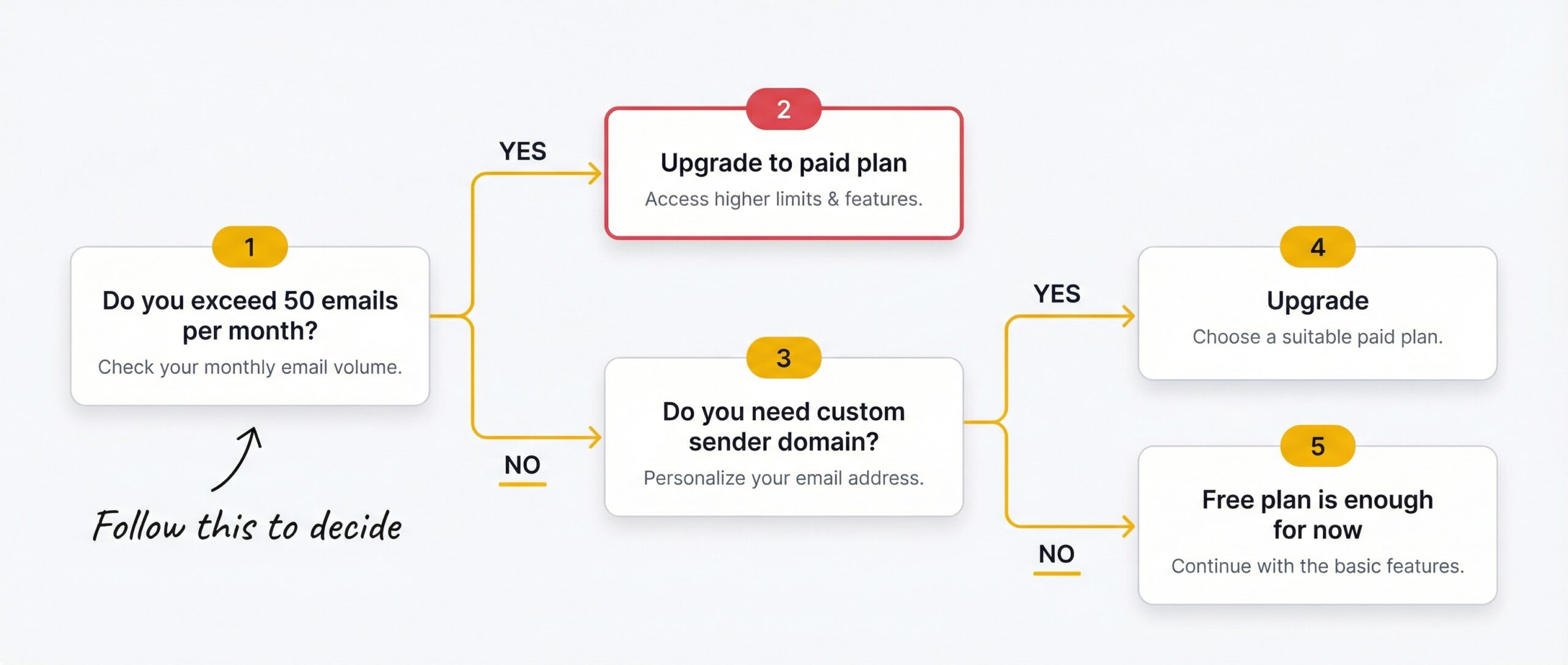
Not every store needs the same features. Here’s a quick framework based on where your store is right now.
Your priority is simple setup with no code required. You want the “Notify Me” button working within minutes, not hours.
Best picks: StoreBeep or STOQ. Both install automatically and start capturing demand immediately. StoreBeep gives you 50 free emails per month, and if you later want to add WhatsApp alerts or a custom sender domain, you can upgrade without switching apps.
If you only run out of stock on a few products each month, a free plan’s 50-email cap should cover you. Focus on apps with reliable email delivery and clean notification templates.
Best picks: StoreBeep, Notify!, or SC Back in Stock. These all handle basic email alerts reliably on their free plans.
True multi-channel alerting on free plans is rare. Most apps gate SMS and WhatsApp behind paid tiers. But StoreBeep collects WhatsApp opt-ins even on the free plan, which means you’re building that subscriber list now and can activate WhatsApp sending when you upgrade. Omnisend reports that back in stock automations achieve a 58.03% open rate and 21.19% click rate (Omnisend, 2025), so the email channel alone delivers strong results while you grow into additional channels.
Best pick: StoreBeep (collects WhatsApp for free) or Back in Stock Duck (WhatsApp-focused).
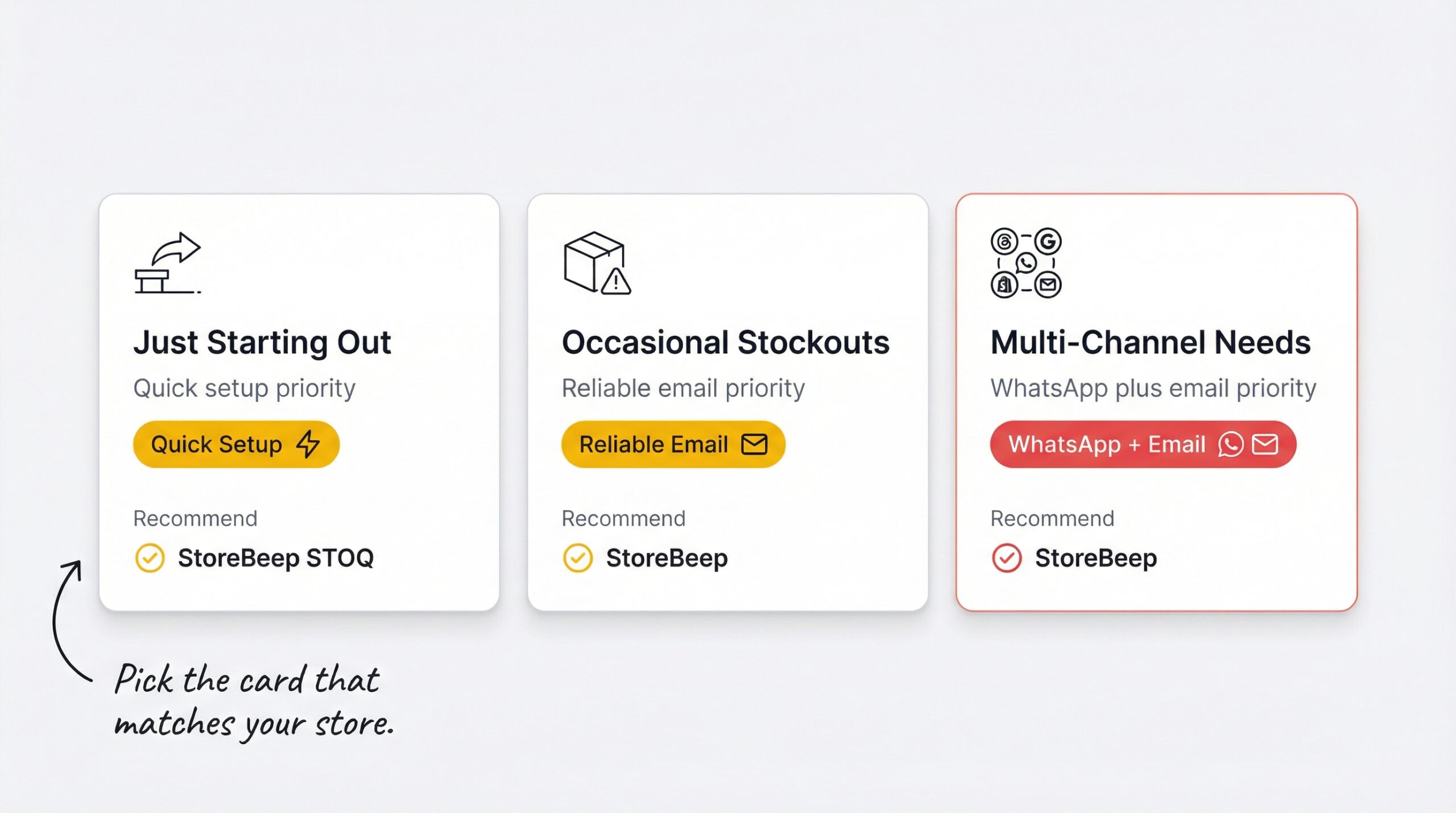
| Store type | Top priority | Recommended apps |
|---|---|---|
| Just starting out | Quick setup, no code | StoreBeep, STOQ |
| Occasional stockouts | Reliable email alerts | StoreBeep, Notify!, SC Back in Stock |
| Multi-channel needs | WhatsApp + email | StoreBeep, Back in Stock Duck |
| Klaviyo users | ESP integration | Appikon |
| Preorder + restock | Combined workflow | STOQ |
What is the best free back in stock app for Shopify?
StoreBeep, STOQ, and Notify! all offer genuinely free plans with no time limit. The best choice depends on your needs: StoreBeep for WhatsApp collection and custom sender domains on paid tiers, STOQ for combined preorder and restock functionality, and Notify! for the widest channel support.
Are free back in stock apps really free?
Yes, most offer a permanent free plan, not just a free trial. The limits are typically 10 to 50 emails per month, app branding on notifications, and restricted access to features like analytics, SMS, and WhatsApp sending.
How many emails can I send on a free back in stock plan?
Most free plans allow 10 to 50 emails per month. StoreBeep offers 50 free emails monthly, while Alert Me! caps at 10. Once you hit the limit, remaining subscribers won’t receive alerts until the next billing cycle.
Do free back in stock apps support WhatsApp or SMS?
Most free plans are email-only. StoreBeep collects WhatsApp opt-ins even on the free plan, though sending requires a paid plan. Notify! and Back in Stock Duck offer some WhatsApp functionality, but full multi-channel alerts typically require upgrading.
Can I remove the app’s branding from free plan notifications?
No, free plans almost always include “Powered by [App Name]” on notification emails. Removing branding requires a paid plan, typically starting at $5 to $10 per month.
How much revenue can a free back in stock app recover?
A store with 50 monthly signups and a $50 average order value could recover roughly $550 per month, since back in stock emails convert at approximately 22% (MarketingSherpa, 2024). Annual recovery from a free app could reach $6,600.
When should I upgrade from a free to paid back in stock plan?
Upgrade when your monthly subscriber notifications consistently exceed the free plan limit, when you need a custom sender domain for email deliverability, or when you want purchase tracking to measure actual ROI from restock alerts.
Do free back in stock apps slow down my Shopify store?
No, modern back in stock apps use asynchronous loading, so the “Notify Me” button loads after the rest of your page. This prevents any impact on page speed or Core Web Vitals scores.
Can I use a free back in stock app with Klaviyo?
Yes. Appikon offers direct Klaviyo integration even on lower tiers. Apps like StoreBeep let you export subscriber data via CSV to import into Klaviyo or any email platform you already use.
What happens when I hit the free plan’s email limit?
Subscribers who sign up after the limit is reached won’t receive restock alerts until the next billing cycle resets. Their signup data is saved, but the notification doesn’t send, which means potential revenue is lost each month you exceed the cap.
Free back in stock apps on Shopify work. They capture demand, send automated alerts, and recover revenue you’d otherwise lose to competitors. The limitations are real (email caps, branding, limited channels), but for many stores, a free plan is enough to prove the concept and start recovering sales.
Here’s what matters most:
The StoreBeep restock notification app offers 50 free emails per month with WhatsApp collection built in. Install it in under five minutes, start capturing demand on your out-of-stock pages, and let the results tell you when it’s time to grow.
Keep reading