February 15, 2026 · Gaurav Radadiya
65.32% open rates. That is not a typo. Automated restock emails on Shopify consistently outperform every other email type by a massive margin (Barilliance, 2024). While your standard marketing newsletter barely cracks 20%, restock notifications hit inboxes with urgency that customers actually care about.
Here is the problem: most Shopify merchants either skip automated restock emails entirely or assume they need Klaviyo’s complex flow builder to set them up. Neither is true. Dedicated back-in-stock apps handle restock emails with less setup time, lower cost, and features Klaviyo does not offer, like WhatsApp alerts and demand insights.
This guide walks you through the full setup process for automated restock emails on Shopify. You will learn which app to install, how to configure triggers and templates, what makes restock emails convert at 22.45% (MarketingSherpa, 2024), and how to calculate your exact revenue recovery. No Klaviyo required.
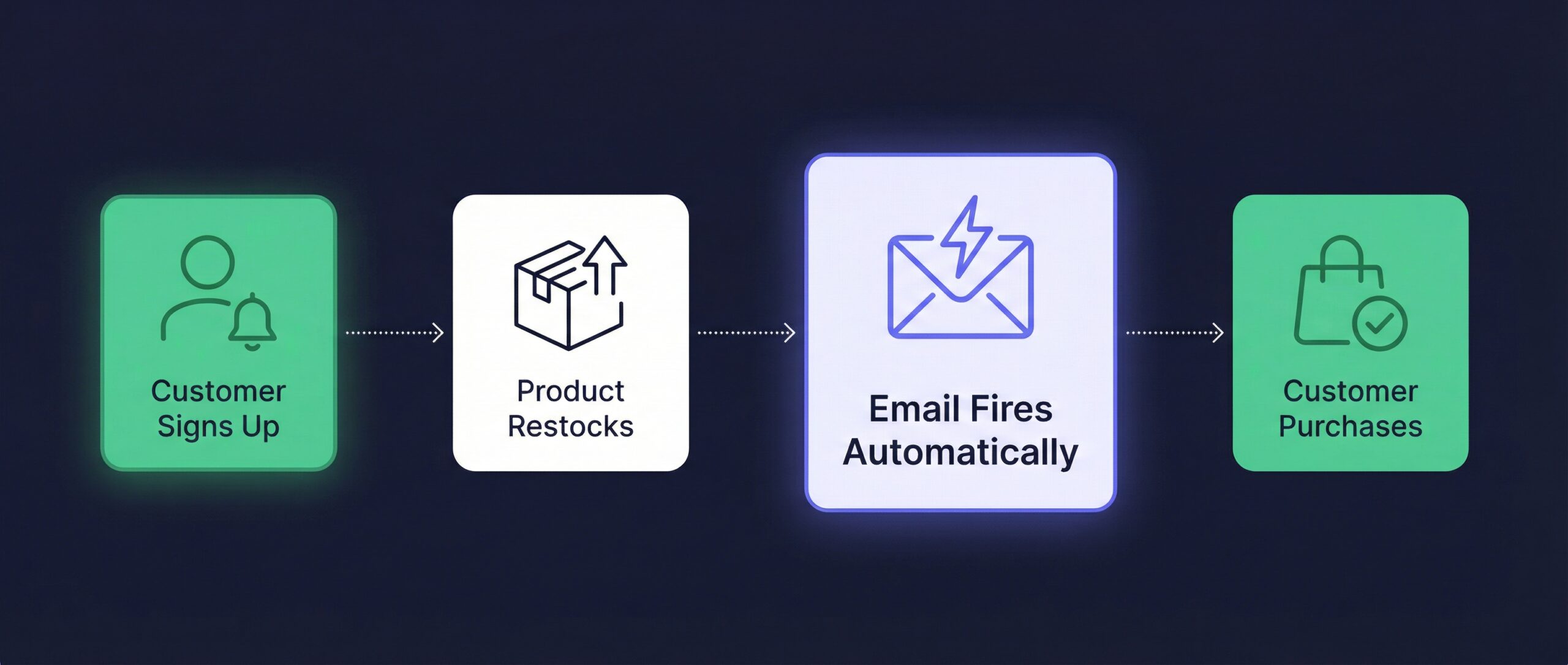
Automated restock emails are triggered notifications that Shopify sends to customers who signed up for a product waitlist when that product returns to stock. They run without manual intervention. The moment your inventory updates, subscribed customers receive an email alerting them the product is available again.
The workflow is simple:
This is fundamentally different from marketing emails. Restock notifications are transactional in nature. The customer already expressed buying intent. They want your product. They asked you to tell them when it is back. That intent is why transactional emails see 8x higher opens and clicks compared to marketing emails (Omnisend, 2025).
The distinction matters for your email strategy. Restock emails are not competing with newsletters for attention. They are delivering information the customer specifically requested.
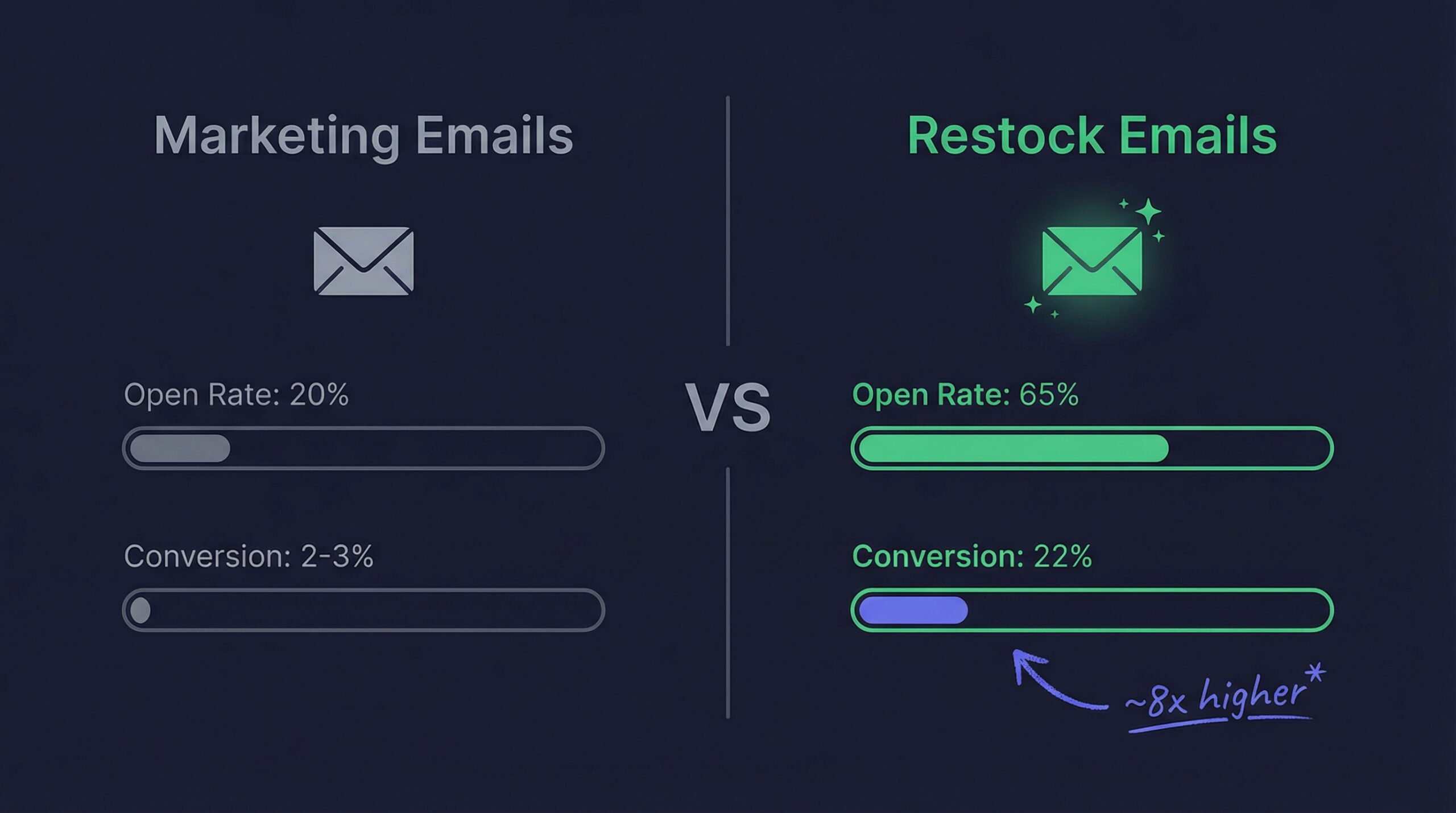
The numbers behind restock emails are unlike anything else in email marketing. Here is a breakdown of how they compare to other automated flows:
| Email Type | Open Rate | Click Rate | Conversion Rate | Revenue Per Email |
|---|---|---|---|---|
| Restock alerts | 65% | 30-35% | 5-22% | Highest |
| Cart abandonment | 45% | 8-10% | 5-10% | High |
| Welcome series | 50% | 10-15% | 2-5% | Medium |
| Newsletter | 20% | 2-3% | 0.5-1% | Low |
| Promotional blast | 15% | 1-2% | 0.3-0.5% | Lowest |
Three factors drive this performance:
Pre-qualified intent. These customers already chose your product. They browsed, evaluated, and decided to buy. The only reason they did not complete the purchase is inventory. When you remove that barrier, conversion follows naturally.
Urgency and scarcity. Customers who signed up for restock alerts know the product sold out before. That creates real urgency. They understand it could sell out again, so they act quickly when the email arrives.
Timing precision. Automated restock emails arrive at the exact moment of relevance, not on a scheduled cadence. Automated emails generate 40% of all email-attributed revenue while representing only 3% of total send volume (Omnisend, 2025). That efficiency is hard to match with any other channel.
Let us run the numbers on what automated restock emails mean for your store.
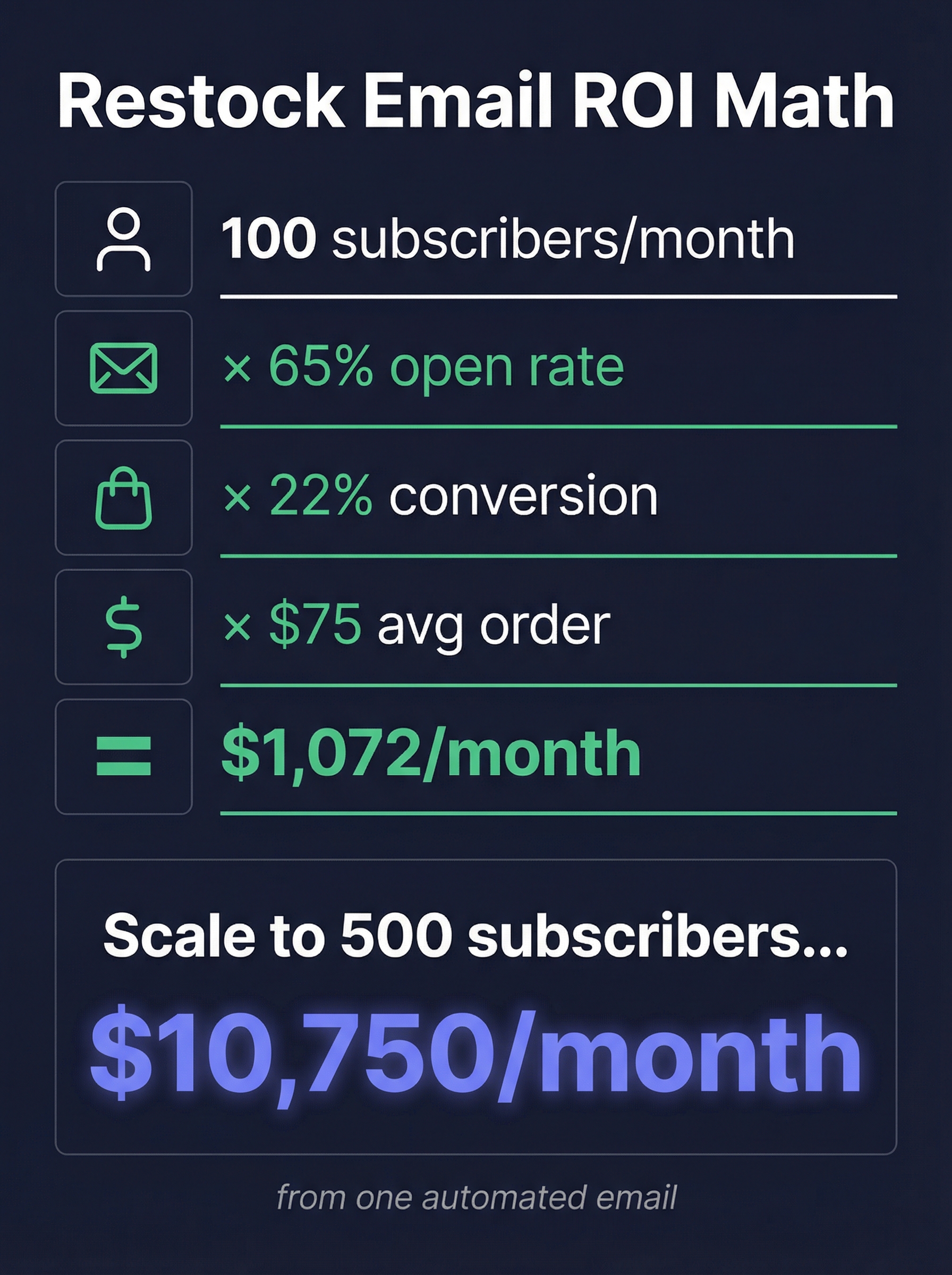
Assume you have 500 subscribers across your waitlists. With a 65% open rate, 325 people see your email. At a 30% click rate, 97 people visit your product page. At a conservative 10% purchase rate with a $50 average order value:
That is $500 recovered from a single product restock, automatically, with zero manual effort. Scale this across 20 products that restock monthly, and you are looking at $10,000 in recovered revenue every month.
Stockouts cost retailers $1.2 trillion globally per year (IHL Group, 2024). Automated restock emails recapture a meaningful portion of that lost revenue for your store.
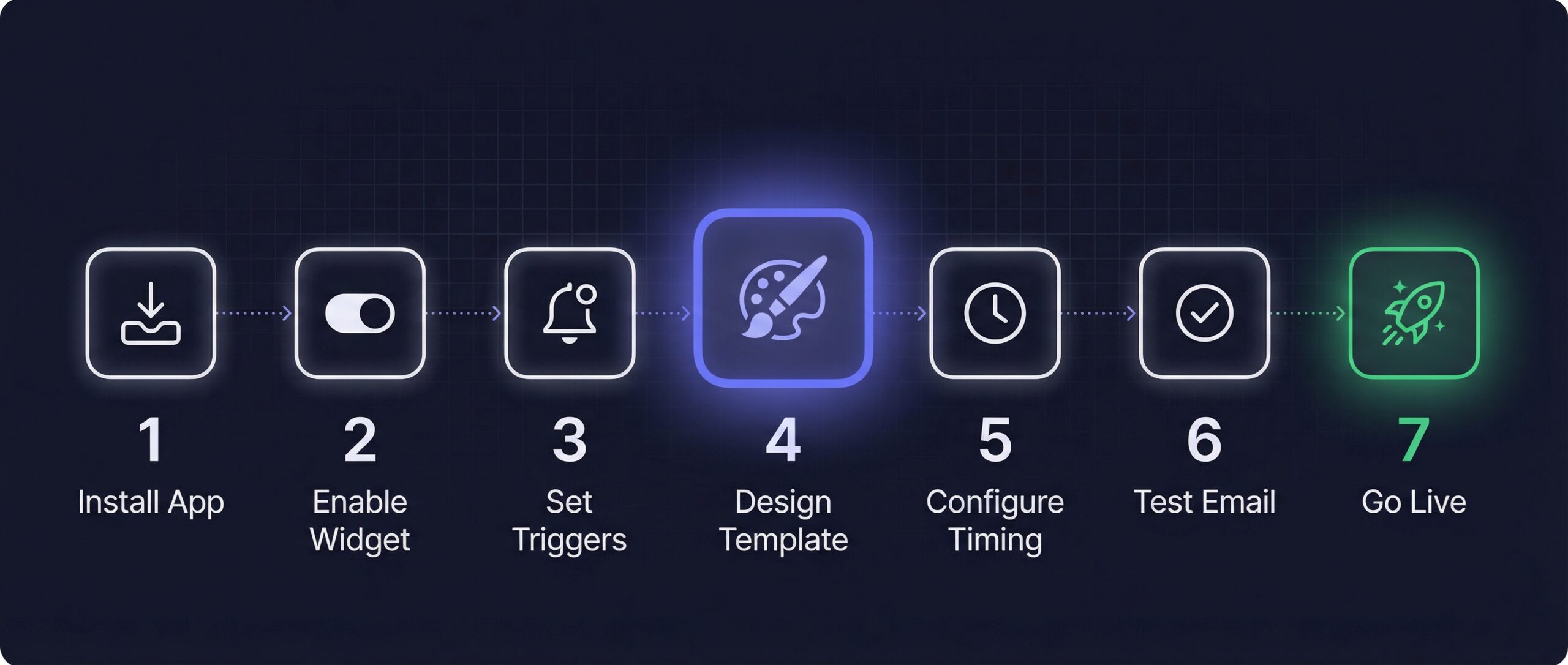
You do not need Klaviyo, Mailchimp, or any complex email platform to send restock alerts. Dedicated back-in-stock apps handle everything from the Notify Me button to the automated email send. Here is the step-by-step setup.
Go to the Shopify App Store and install a dedicated back-in-stock notification app. Apps like StoreBeep are purpose-built for restock alerts, meaning you skip the complex flow-building process that platforms like Klaviyo require.
What to look for in a back-in-stock app:
Once the app is installed, it automatically places a “Notify Me” button on your out-of-stock product pages. You can customize:
If you need a detailed walkthrough, check out our guide on how to add a Notify Me button on Shopify.
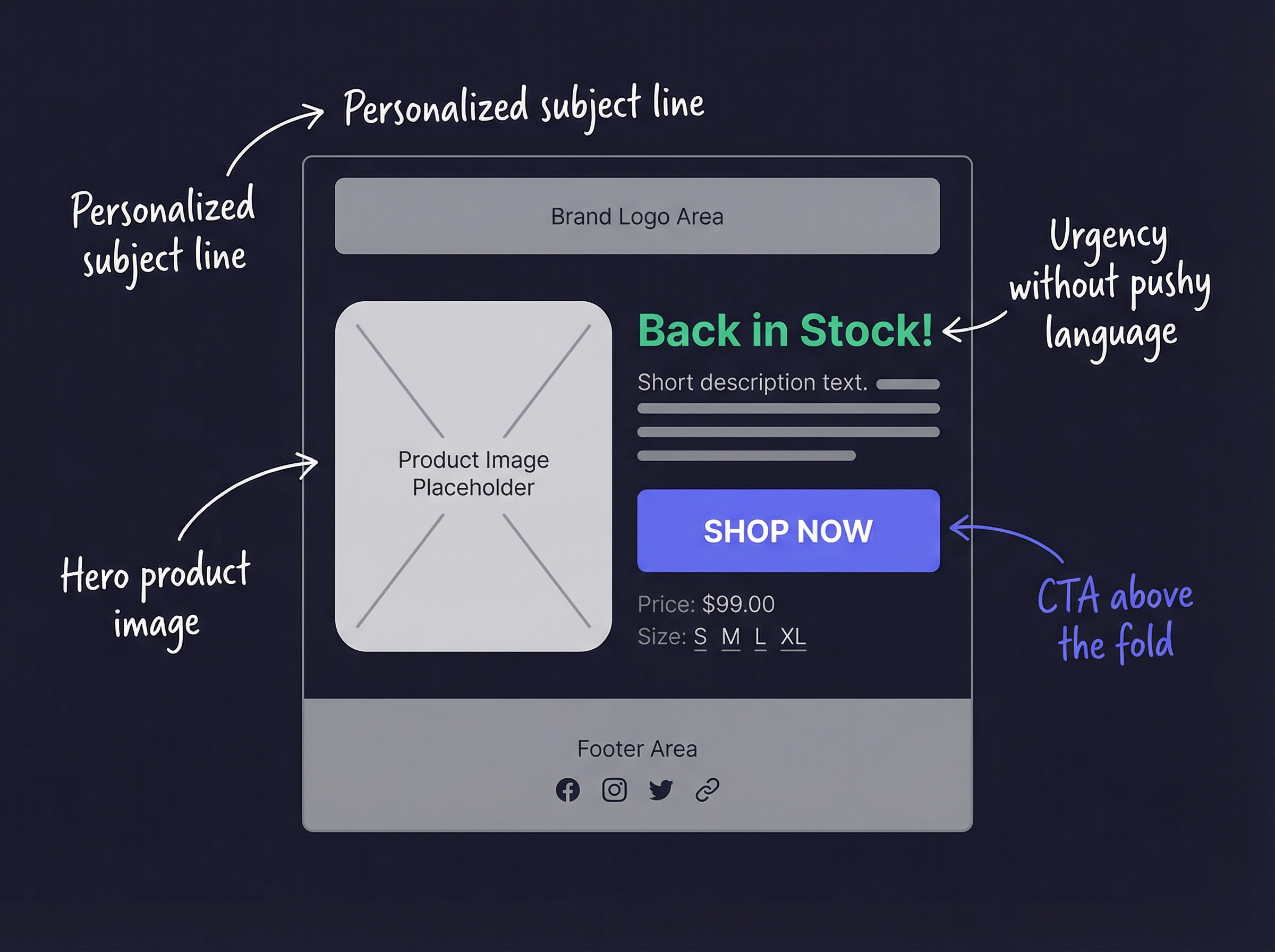
Your restock email template should be clean, focused, and action-oriented. Key elements include:
Keep the email short. Customers already know what they want. Your job is to get them to the product page as quickly as possible.
Configure the minimum inventory quantity that triggers automatic alerts. Most stores set this to 1 (send alerts as soon as any stock is added), but you might want a higher threshold if:
For professional emails that avoid spam folders, set up a custom sender domain. Instead of notifications arriving from a generic app address, they come from [email protected]. This builds trust and improves deliverability.
We cover this process in detail in our custom sender domain setup guide (publishing soon).
Before going live, test the full workflow:
This catches formatting issues, broken links, and timing delays before real customers experience them.
The difference between a 5% and 22% conversion rate often comes down to email design details. Here is what the data shows works best.
64% of people decide whether to open an email based on the subject line alone (Appikon, 2025). For restock emails, specificity beats cleverness:
| Subject Line Formula | Example | Why It Works |
|---|---|---|
| [Product Name] is back in stock | “Air Max 90s Are Back in Stock” | Direct, product-specific |
| Good news: [Product] is available again | “Good news: The Ceramic Mug Set is available again” | Positive framing |
| [Product] is back (limited stock) | “Blue Linen Dress is Back (Limited Stock)” | Urgency + specificity |
| Your waitlisted item just restocked | “Your waitlisted item just restocked” | Personal, action-oriented |
Avoid generic subject lines like “New arrivals!” or “Check out what is new.” Those perform like standard marketing emails. The power of restock emails is in the specificity.
Send restock emails within 5 minutes of inventory updating. Every hour you delay reduces conversion rates. Customers who signed up weeks ago may have already found an alternative. Speed recaptures those who are still waiting.
Products that go out of stock remain unavailable for an average of 35 days (8fig, 2025). That is 35 days your customers have been waiting. When inventory finally arrives, instant notification is critical.
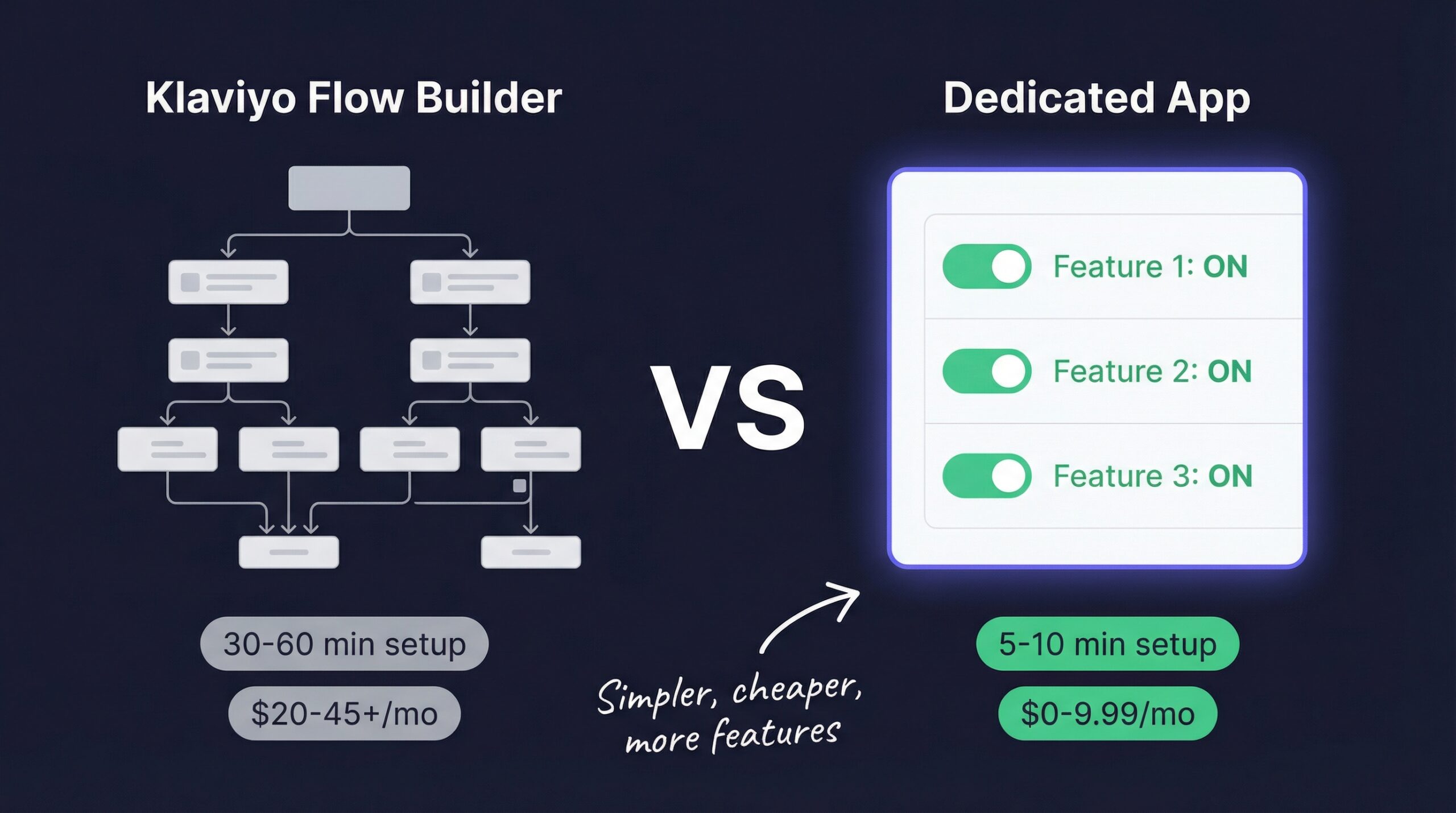
This is the most common question Shopify merchants ask about restock emails. Here is an honest comparison:
| Feature | Klaviyo Back-in-Stock Flow | Dedicated App (e. g., StoreBeep) |
|---|---|---|
| Setup complexity | High (build custom flow) | Low (install and configure) |
| Setup time | 30-60 minutes | 5-10 minutes |
| Monthly cost | $20-45+ (platform fee) | $0-9.99 (app fee) |
| Automatic triggers | Requires flow configuration | Built-in automatic sends |
| Custom sender domain | Included at higher tiers | Available on Pro ($9.99) |
| WhatsApp alerts | Not available | Available |
| Demand insights | Limited | Built-in dashboard |
| Purchase tracking | Via Klaviyo analytics | Built-in conversion tracking |
| Newsletter opt-in | Separate form needed | Built into signup form |
| Requires Klaviyo subscription | Yes | No |
If you already pay for Klaviyo and use it extensively for email marketing, adding a back-in-stock flow keeps everything in one platform. The flow builder lets you add conditional logic, delays, and multi-email sequences.
For most Shopify stores, especially small-to-mid-size merchants, a dedicated app is the better choice. You skip Klaviyo’s monthly fee, get faster setup, and gain features like WhatsApp collection and demand insights that Klaviyo does not offer.
E-commerce brands with automated campaigns see 320% more revenue per email compared to newsletters (Omnisend, 2025). Whether you use Klaviyo or a dedicated app, the key is getting automation running. A dedicated app removes the setup friction.
Email is the foundation, but it is not the only channel. Here is how different notification channels compare for restock alerts:
| Channel | Open Rate | Cost Per Send | Setup Complexity | Best For |
|---|---|---|---|---|
| 65% | $0.001-0.003 | Low | Primary channel, universal reach | |
| 98% | $0.03-0.08 | Medium | High-value products, engaged customers | |
| SMS | 90% | $0.01-0.05 | Medium | Time-sensitive restocks |
| Push notifications | 5-15% | Free | Low | Supplementary, app-based stores |
Email remains the strongest combination of reach, cost, and conversion. But WhatsApp is emerging as a powerful complement, especially for Shopify stores with international customers. Our guide on WhatsApp back-in-stock alerts on Shopify covers this channel in depth.
The best approach for most stores: collect emails as the primary channel, offer WhatsApp as an optional add-on during signup, and use both channels for high-demand products.
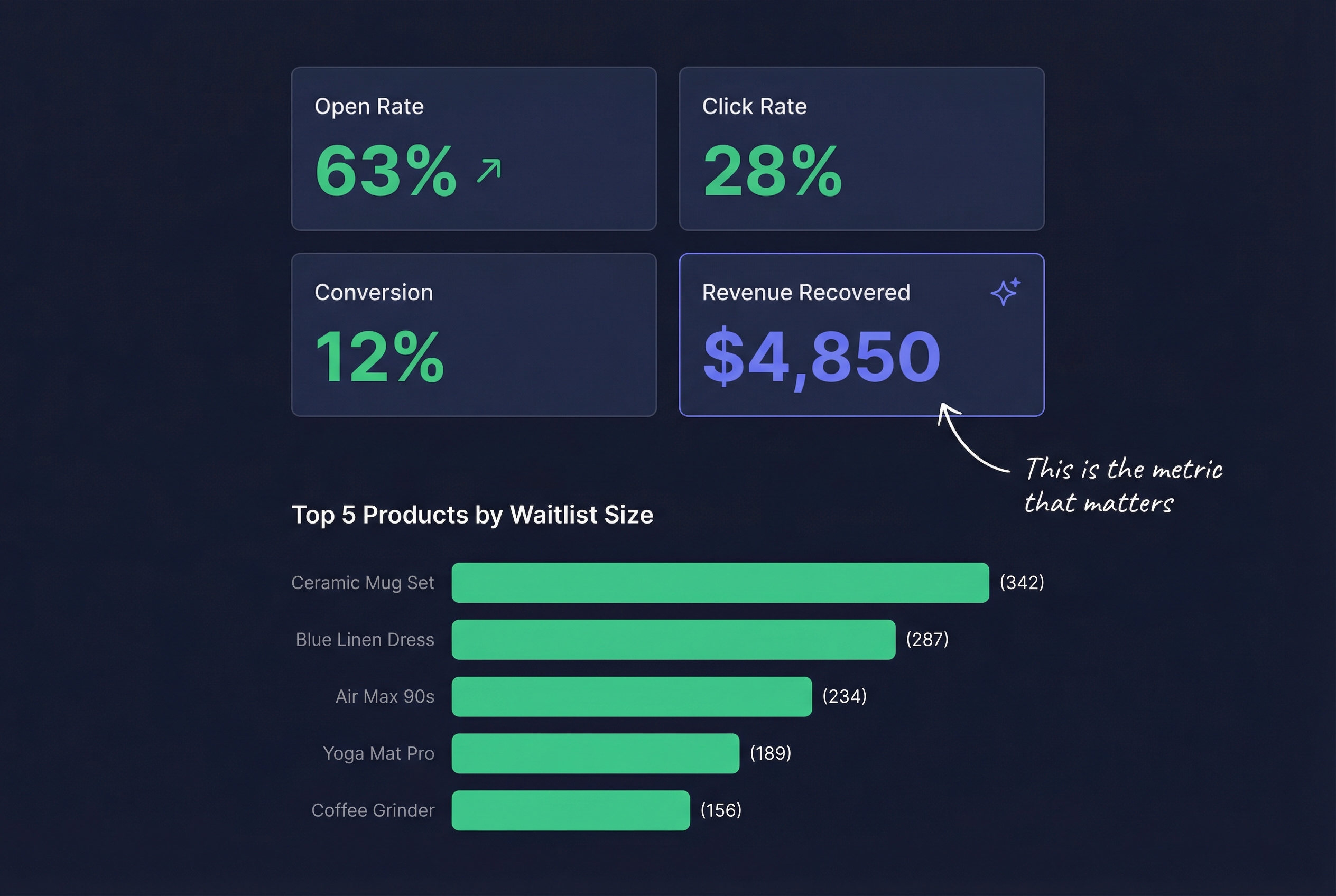
Tracking your restock email performance ensures you know exactly what revenue they recover. Here are the key metrics to monitor:
| Metric | What It Measures | Good Benchmark |
|---|---|---|
| Open rate | Email visibility | 50-65% |
| Click-through rate | Interest level | 25-35% |
| Conversion rate | Purchase completion | 5-15% |
| Revenue per email | Dollar value per send | Varies by AOV |
| Recovery rate | % of waitlist that converts | 8-15% |
| Subscriber growth | Waitlist size over time | Steady increase |
Monthly recovered revenue =
(Total subscribers alerted) x (Open rate) x (Click rate) x (Conversion rate) x (AOV)
Track this monthly. If your conversion rate drops below 5%, review your email template, subject lines, and send timing. If subscriber counts plateau, check that your Notify Me button is visible and compelling on product pages.
Purchase tracking built into your back-in-stock app connects the dots automatically. You can see which specific alerts led to completed orders, giving you exact revenue attribution.
Understanding how much revenue stockouts cost your business provides important context for these calculations. Our article on what stockouts actually cost your Shopify store breaks down the full financial impact.
Automated restock emails are triggered notifications sent to customers who signed up for a product waitlist when that product returns to stock. They run automatically without manual intervention and typically achieve 65% open rates.
No. Dedicated back-in-stock apps like StoreBeep handle restock emails without Klaviyo. They are simpler to set up, cost less, and include features Klaviyo lacks like WhatsApp alerts and demand insights.
Back-in-stock emails achieve approximately 65% open rates (Barilliance, 2024), compared to 20-25% for standard marketing emails. This makes them the highest-performing automated email type.
Restock emails should be sent within minutes of inventory being updated. Delays reduce conversion rates because customers may have already purchased from a competitor or lost interest.
A high-converting restock email includes the product name and image, current price, a clear CTA button linking directly to the product page, and optional urgency messaging about limited stock.
Yes. Apps like StoreBeep collect WhatsApp numbers alongside email during signup. WhatsApp restock alerts achieve 98% open rates, making them an effective complement to email notifications.
Most back-in-stock apps include purchase tracking that connects alert sends to completed orders. This shows your exact recovery rate and revenue attributed to restock notifications.
Restock emails convert at 5-22% depending on product type and timing. The industry benchmark is 5-7% (Omnisend, 2025), with top performers reaching 22% (MarketingSherpa, 2024).
Yes. Custom sender domains improve deliverability and brand recognition. Emails from [email protected] build more trust than emails from a generic third-party app domain.
Send one primary notification when the product restocks. If the subscriber does not purchase within 48-72 hours, send one follow-up reminder. Two emails per restock event is the sweet spot.
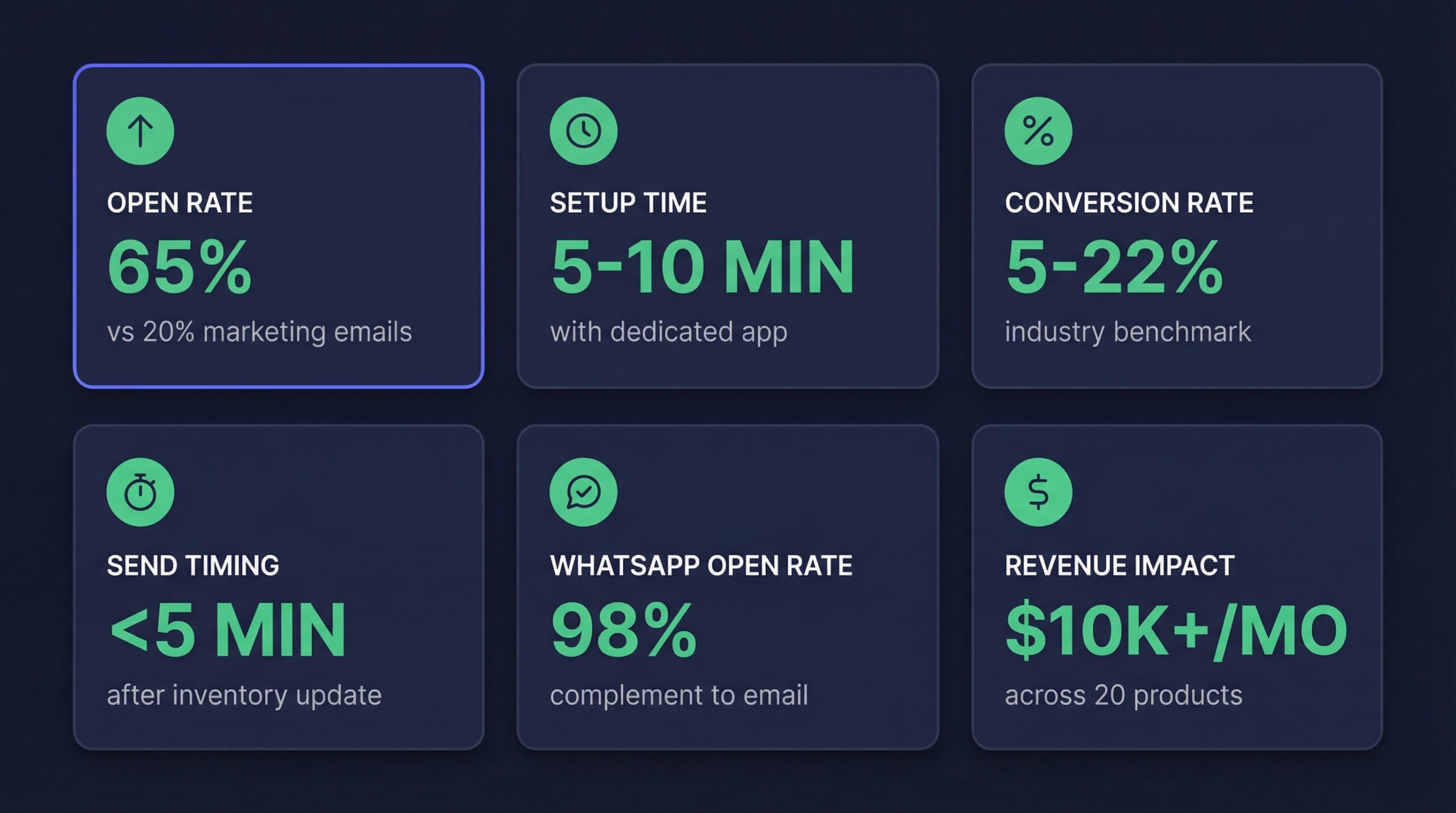
Automated restock emails on Shopify are the highest-ROI email automation you can set up. The math is clear:
You do not need Klaviyo. You do not need a developer. You do not need complex email flows. A dedicated back-in-stock alerts app gets you up and running in under 10 minutes.
Every day without automated restock emails is revenue walking out the door. 69% of shoppers go straight to a competitor when their item is out of stock (Opensend, 2024). Capture that demand now, and let automation bring them back when you restock.
For a broader look at how restock alerts fit into your Shopify notification strategy, read our guide on Shopify notification systems and how they recover revenue.
Keep reading